Italy — A Country It Is Impossible Not to Fall in Love With
A Complete Guide to Italy: History, Culture, Cities, Traditions and Places That Inspire You to Travel
More Than Famous Attractions
Italy cannot be understood through a list of attractions alone. Beyond its famous cities, ancient monuments and masterpieces lies a rich world of regional diversity. Over centuries, local dialects, traditions, cuisine, music, cinema, architecture and customs have developed their own distinctive character.
Moreover, the past has never been confined to museums. Instead, it remains part of everyday life, from historic squares and city streets to family traditions and regional dishes.
From the Alps to the Mediterranean
Italy’s diversity is reflected in its landscapes and cities. In the north, snow-covered Alps contrast with Mediterranean islands in the south. Meanwhile, majestic Rome and elegant Milan offer a different experience from small towns where life seems to move at a slower pace.
Why Do Millions of People Choose Italy?
Every year, Italy ranks among the world’s most visited countries. Travellers are drawn to its history, art, landscapes and distinctive way of life.
For some, the grandeur of Ancient Rome and the Colosseum is the main attraction. Others prefer the romance of Venice’s canals. Art enthusiasts, meanwhile, come to admire masterpieces by Leonardo da Vinci and Michelangelo, while beach lovers seek sunny shores and warm seas.
Beyond these famous attractions, many visitors appreciate life’s simpler pleasures: fresh coffee in the morning, walks through historic streets and the atmosphere captured by the expression La Dolce Vita — “the sweet life”.
What Makes Italy Unique?
In this article, we will explore Italy as a whole, from its history and geography to its people and culture. Along the way, we will discover its cities, natural landscapes, architecture and cuisine to understand what makes this country truly Italian.
Key Facts
- Capital: Rome
- Largest cities: Rome, Milan, Naples, Turin and Palermo
- Population: approximately 58.9 million
According to preliminary ISTAT data as of 30 June 2026, the population was 58,943,673. - Area: 302,073 km²
- Currency: euro (€)
- Time zone: CET (UTC+1) in winter, CEST (UTC+2) in summer
- International dialling code: +39
- Internet domain: .it
- Official language: Italian
- Form of government: parliamentary republic
- President: Sergio Mattarella, in office since 2015 and re-elected in 2022
- Prime Minister: Giorgia Meloni, in office since 2022
- National holiday: 2 June — Republic Day (Festa della Repubblica)
Geography
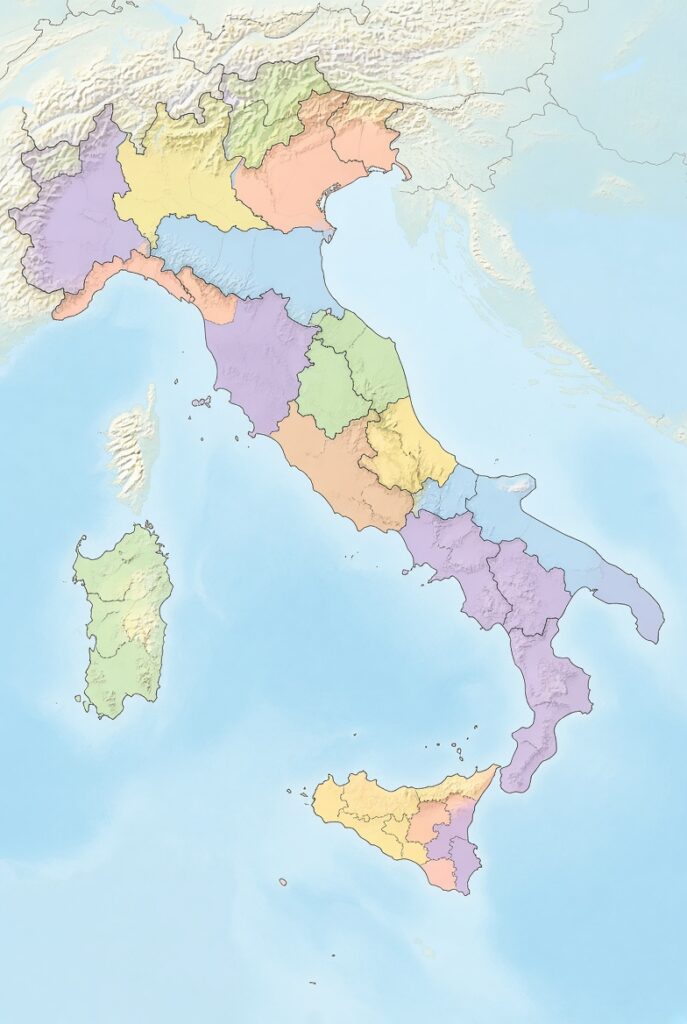
Where Is Italy Located?
Italy is located in southern Europe, in the central part of the Mediterranean. Most of the country lies on the Italian Peninsula, which extends far into the sea and resembles the shape of a boot. In the north, Italy connects to the European mainland and reaches the Alps. To the south, the peninsula gradually extends into the Mediterranean Sea.
The country also includes the large islands of Sicily and Sardinia, as well as numerous smaller islands. Its geographical location largely shapes Italy’s character: here, high mountains lie alongside coastal areas, vast plains and rolling hills covered with vineyards, while volcanoes, lakes and island landscapes add to the country’s diversity.
Main Regions
Italy consists of 20 regions, each with its own landscape, history and cultural characteristics.
Northern Italy
Aosta Valley — the Alps, mountain valleys and famous peaks. Piedmont — Turin, the Alps, vineyards and gastronomic traditions. Lombardy — Milan, Lakes Como and Garda, the Alps and one of the country’s main economic centres. Liguria — the Mediterranean Sea, Genoa and the picturesque coastline of Cinque Terre. Trentino–Alto Adige — the Dolomites, mountain lakes and Alpine valleys. Veneto — Venice, the Dolomites, Lake Garda and the Adriatic coast. Friuli Venezia Giulia — mountains, the Adriatic Sea and the cultural influence of neighbouring countries. Emilia-Romagna — Bologna, Ravenna, Parma and Italy’s renowned gastronomic traditions.
Central Italy
Tuscany — Florence, rolling hills, vineyards, cypress trees and the heritage of the Renaissance. Umbria — green hills, medieval towns and Assisi. Marche — the Adriatic coast, hills, mountains and historic towns. Lazio — Rome, ancient heritage and the Tyrrhenian coast.
Southern Italy
Abruzzo — the Apennines, national parks and the Adriatic coast. Molise — a small region with mountain landscapes, medieval towns and a coastline. Campania — Naples, Pompeii, Mount Vesuvius, the Amalfi Coast and islands. Apulia (Puglia) — a long coastline, olive groves, whitewashed towns and unique trulli houses. Basilicata — mountains, rugged landscapes and the ancient city of Matera. Calabria — mountains, forests and coastlines along two seas.
Insular Italy
- Sicily — the largest island in the Mediterranean, home to Mount Etna, ancient cities and diverse natural landscapes.
- Sardinia — mountains, wild coastlines, crystal-clear waters and a distinctive island culture.
The diversity of Italy’s regions is clearly reflected in its landscapes, ranging from snow-covered Alpine peaks in the north to warm Mediterranean shores in the south.
Climate
Italy’s climate varies considerably from north to south and depends on altitude and proximity to the sea. In the north, particularly in the Alps, winters are cold and snowy. In the central part of the country, the climate is milder, while coastal areas are influenced by the Mediterranean Sea. Southern Italy and the islands have a warmer climate, with hot summers and relatively mild winters.
However, even within a single region, the weather can vary considerably: mountain areas are cooler than the coast. As a result, Italy’s natural landscapes are remarkably diverse, ranging from glaciers and Alpine meadows to Mediterranean vegetation and dry southern scenery.
🌿 An Interesting Geographical Fact
Italy is a country of contrasts: its territory stretches for approximately 1,200 kilometres from north to south, so the landscape and climate change noticeably as you travel along the peninsula.
Which Countries Border Italy?
Italy shares land borders with France, Switzerland, Austria and Slovenia.
In addition, two independent states are located within Italian territory: Vatican City and San Marino.
Seas and Oceans
Italy is surrounded by the waters of the Mediterranean Sea.
Its main subdivisions include:
- The Adriatic Sea — to the east;
- The Ionian Sea — to the south;
- The Tyrrhenian Sea — to the west;
- The Ligurian Sea — to the north-west.
Thanks to its geographical location, Italy has an extensive coastline and a great variety of coastal landscapes.
Highest Point
Mont Blanc (Monte Bianco) — approximately 4,810 m.
The massif is located in the Alps, on the border between Italy and France. The two countries have historically interpreted the exact course of the national border near the summit differently.
Longest River
The Po (Po) is Italy’s longest river, stretching for approximately 652 km. Originating in the Alps, it crosses the northern part of the country before flowing into the Adriatic Sea. Surrounding the river, the Po Valley forms one of Italy’s largest lowland areas.
Largest Lake
Lake Garda (Lago di Garda) is the largest lake in Italy.
It lies between the Alps and the Po Valley, within the regions of Lombardy, Veneto and Trentino–Alto Adige. The shores of Lake Garda are known for their mountains, small historic towns, castles and Mediterranean vegetation.
Islands
The country’s two largest islands are Sicily and Sardinia.
Sicily lies off the southern tip of the Italian Peninsula and is known for Mount Etna, its mountainous areas and its long coastline.
Sardinia is located to the west of mainland Italy. It is characterised by mountainous terrain, rocky shores, sandy beaches and Mediterranean landscapes.
In addition to these, Italy includes numerous smaller islands and archipelagos, ranging from the Aeolian Islands off Sicily to the islands of the Tuscan Archipelago.
National Parks
Italy’s natural areas are protected within national parks and other protected areas.
Some of the best-known national parks include:
- Gran Paradiso — the Alps;
- Stelvio — one of the largest mountain national parks in the country;
- Abruzzo, Lazio and Molise — mountain forests and habitats of rare animals;
- Cinque Terre — the mountainous coastline of Liguria;
- Vesuvius — the area surrounding the famous volcano;
- Tuscan Archipelago — protected island areas;
- Pollino — mountainous landscapes in the south of the country.
Italy’s Natural Features
Italy’s landscape cannot be described in a single word. The Alps lie in the north, while the Apennines stretch along the entire Italian Peninsula. The extensive Po Valley, associated with the Po River basin, is also located in the north. This is also where Italy’s famous lakes can be found — Lake Garda, Lake Como and Lake Maggiore.
Volcanoes hold a special place in Italy’s natural landscape. Italy is one of the few countries in Europe with active volcanoes, including Mount Etna, Mount Vesuvius and Stromboli.
Along the coastlines and on the islands, the landscape changes once again: mountains descend towards the sea, giving way to rocky shores, sandy beaches, Mediterranean forests and small islands.
Italy’s Extreme Points
Italy’s geographical position can also be understood by looking at its extreme points:
- North: the Winnebachwald area in South Tyrol, near the Austrian border.
- South: the island of Lampedusa.
- East: Cape Otranto in Apulia.
- West: the Val di Roia area in Liguria, near the French border.
It is precisely this great distance between the north and the south that helps explain why Italy is so diverse: a single country brings together the Alps, plains, volcanoes, islands, lakes and several thousand kilometres of coastline.
Nature
Mountains
- The Alps occupy the northern part of Italy and form a natural border with France, Switzerland, Austria and Slovenia.
- The Apennines run through almost the entire Italian Peninsula from north to south. The highest mountains in Italy are located in the Alps.
- Among the best-known mountain areas are the Dolomites, part of the Alps and a UNESCO World Heritage Site.
- Italy’s highest point is Mont Blanc (Monte Bianco), approximately 4,810 m, in the massif on the border between Italy and France.
- The Apennines include some of the highest peaks in this mountain range: Corno Grande (2,912 m) and Monte Amiata (1,738 m).
Lakes
Italy has thousands of lakes, ranging from small mountain lakes to large glacial lakes.
- Lake Garda — the largest lake in Italy.
- Lake Como is known for its deep waters and mountain scenery.
- Lake Maggiore is located in northern Italy and extends partly into Switzerland.
- In central Italy lies Lake Trasimeno, the largest lake on the Italian Peninsula. Most of the country’s largest lakes are located in the north, at the foot of the Alps.
Rivers
- The Po is Italy’s longest river, at approximately 652 km. It rises in the Alps and flows into the Adriatic Sea.
- The Adige is Italy’s second-longest river, at approximately 410 km.
- The Tiber flows through Rome and empties into the Tyrrhenian Sea.
- The Arno flows through Florence and Pisa.
Italy’s rivers vary considerably in character: Alpine rivers are fed by snow and glaciers, while many rivers in the central and southern parts of the country have a more seasonal flow.
Forests
Forests cover a significant part of Italy, particularly in the mountainous areas of the Alps and the Apennines. Beech, oak, chestnut and coniferous forests are widespread in the northern and central regions. In the south and on the islands, Mediterranean forests and shrubland predominate.
National parks preserve extensive forest areas and natural habitats for many animal species. Some of the best-known forest areas are found in Abruzzo, Calabria, Sila and the Tuscan-Emilian Apennines.
Unusual Natural Phenomena
- Acqua alta — the periodic rise in water levels in the Venetian Lagoon, which can temporarily flood some of Venice’s squares and streets.
- In the mountains, glacial lakes, waterfalls and deep gorges can be found, shaped by glacial and river erosion.
- Volcanic activity creates unusual landscapes with lava fields, craters and volcanic rock formations.
- In Sicily and other volcanic areas, visitors can see places where the modern landscape is directly linked to eruptions that occurred centuries ago.
- In the mountains of some regions, vast fields of flowering plants appear in spring. One of the best-known locations is the Castelluccio di Norcia plateau in Umbria.
Animals
The diversity of Italy’s natural environments — from the Alps and the Apennines to the Mediterranean coastline and the islands — provides habitats for a large number of animal species.
In mountainous areas, Alpine ibex, chamois, marmots and brown bears can be found. The Apennines are home to Apennine wolves, Marsican brown bears, deer, wild boar and foxes. Some species are particularly rare and require protection, which makes national parks and other protected areas especially important.
Birds
Italy lies along one of the important migration routes between Europe and Africa, so visitors can see not only resident species but also a wide variety of migratory birds.
Different regions are home to golden eagles, peregrine falcons, owls, herons, storks, golden orioles, bee-eaters, gulls and terns. Large concentrations of migratory birds are particularly fascinating in wetlands and coastal areas. Greater flamingos can be found in lagoons and along the coasts of Sardinia and Sicily.
Insects
Italy’s warm climate and diverse landscapes support a rich variety of insects. Numerous species of butterflies, bees, bumblebees, dragonflies, beetles and praying mantises live here.
One of the most characteristic sounds of an Italian summer is the chorus of cicadas. Their continuous chirring is particularly familiar to residents and travellers in Tuscany, Sicily, Apulia and other warm regions. On some natural sites, fireflies can also be seen on summer evenings.
Snakes
Italy is home to many species of snakes, and most of them are non-venomous. These include various grass snakes and whip snakes. Several species of vipers are also found in the country, including the asp viper and the nose-horned viper. Vipers generally avoid humans and do not pose a serious concern for ordinary tourists. You are more likely to encounter a snake while walking in the mountains, forests, on rocky slopes or in the countryside than in the centre of a tourist city.
Scorpions
Scorpions are also found in Italy, although tourists are much less likely to encounter them. The country is home to small species of the genus Euscorpius, which can live under stones, in old walls and in other sheltered places. Italian scorpions are generally not considered dangerous to humans. Their sting can be painful, but it usually does not pose a serious threat to a healthy adult.
Marine Life
The Mediterranean Sea surrounding Italy is also rich in wildlife. Dolphins, sea turtles, various fish and seabirds can be found in coastal waters. Sea turtles are particularly associated with the southern regions and islands.
Italy’s wildlife is therefore far more diverse than its famous cities might suggest. In a single country, you can encounter an Alpine ibex in the mountains, flamingos in a lagoon, cicadas among olive groves and dolphins off the Mediterranean coast.
Volcanoes
Italy is one of the most volcanically active countries in Europe.
The best-known volcanoes are:
- Mount Etna — on the eastern coast of Sicily; one of the highest active volcanoes in Europe. Its height changes due to volcanic activity.
- Mount Vesuvius — near Naples. It is known for the devastating eruption of 79 AD, which destroyed Pompeii and Herculaneum.
- Stromboli — an active volcano on the island of the same name, part of the Aeolian Archipelago.
- Vulcano — an island of volcanic origin in the Aeolian Archipelago, which gave its name to the very concept of a “volcano”.
Italy’s volcanic regions continue to change under the influence of geological processes.
Beautiful Natural Places
- The Dolomites — striking rocky peaks and mountain valleys in northern Italy.
- Lake Como — an Alpine lake surrounded by mountains.
- Lake Garda — the country’s largest lake, with mountain scenery in the north.
- Cinque Terre — the rocky coastline of Liguria, with terraced slopes and sea views.
- The Amalfi Coast — the mountainous coastline of Campania, with steep slopes overlooking the Tyrrhenian Sea.
- Val d’Orcia — the rolling landscape of Tuscany, with cypress trees, vineyards and fields.
- Gran Paradiso — a mountain national park in the Alps.
- Abruzzo, Lazio and Molise National Park — one of the most important natural areas of the Apennines.
- The Castelluccio Plateau — a mountain plain in Umbria, known for its spring flowering.
- Mount Etna — a volcanic landscape in Sicily, with lava fields and craters.
Italy’s natural landscapes are remarkably diverse: within a single country, you can find the Alps and the Apennines, glacial lakes and Mediterranean coastlines, forests, volcanoes, islands and mountain valleys.
History — “History in a Few Minutes”
When Did Italy Emerge?
Modern Italy emerged as a unified state in 1861. Before unification, the Italian Peninsula was divided among various states, including the Kingdom of Sardinia, the Papal States, the Kingdom of the Two Sicilies, the Grand Duchy of Tuscany and others.
- The unification of Italy is known as the Risorgimento — a 19th-century national movement for the country’s political and territorial unification.
- On 17 March 1861, the Kingdom of Italy was proclaimed.
- Rome became part of unified Italy in 1870 and became the capital of the country in 1871.
Who Ruled Italy?
Before the unification of Italy, there was no single ruler of the country. Different parts of the peninsula were governed by different monarchs, rulers and ecclesiastical authorities.
After unification, Italy became a monarchy:
- Victor Emmanuel II — the first king of unified Italy, 1861–1878.
- Umberto I — king from 1878 to 1900.
- Victor Emmanuel III — king from 1900 to 1946.
- Umberto II — the last king of Italy, in 1946.
After the referendum on 2 June 1946, Italy became a republic. The monarchy was abolished, and the royal family left the country.
Major Wars and Conflicts
The history of the Italian lands is closely linked to numerous wars and struggles for power.
- The Punic Wars (264–146 BC) — Rome’s struggle against Carthage for dominance in the Mediterranean.
- The Roman civil wars — a series of conflicts that led to the fall of the Roman Republic and the emergence of the Roman Empire.
- The Italian Wars (1494–1559) — a prolonged struggle among European powers for control of Italian territories.
- The Napoleonic Wars — French forces established control over much of Italy in the late 18th and early 19th centuries.
- The wars of Italian unification in the 19th century led to the creation of a unified state.
- The First World War (1914–1918) — Italy entered the war in 1915 on the side of the Entente.
- The Second World War (1939–1945) — Italy entered the war in 1940 on Germany’s side, but signed an armistice with the Allies in 1943. After this, the country became divided between opposing forces.
When Did Italy Gain Independence?
It is important to clarify that Italy did not gain independence on a single specific day, since a unified Italian state did not exist before the 19th century. The key event was the unification of Italy in 1861.
The main stages were:
- 1859–1860 — wars and political events that accelerated unification.
- 1861 — proclamation of the Kingdom of Italy.
- 1866 — annexation of Venice.
- 1870 — annexation of Rome.
- 1871 — Rome becomes the capital of unified Italy.
Which Empires Left Their Mark?
Italy’s history was shaped by the influence of numerous civilisations and states.
- The Roman Empire — shaped a vast part of Italy’s European cultural and political heritage. Roman law, the Latin language, architecture, roads and the system of cities influenced territories far beyond the Italian Peninsula.
- The Byzantine Empire — had a particularly strong influence on eastern Italy and Ravenna, where famous early Christian and Byzantine mosaics have been preserved.
- The Holy Roman Empire — for centuries, its influence extended across much of northern and central Italy.
- The Arab world — left a particularly notable mark on Sicily. Arab rule influenced the island’s architecture, agriculture, language and culture.
- The Normans — established a powerful state in southern Italy and Sicily, uniting territories that had previously been ruled by different powers.
- The Spanish Empire — controlled significant parts of Italy during the 16th–18th centuries, including Milan and the southern part of the peninsula.
5 Dates Worth Knowing
- 753 BC — the traditional date of the founding of Rome.
- 476 AD — the fall of the Western Roman Empire.
- 1861 — the proclamation of the Kingdom of Italy and the creation of a unified Italian state.
- 1870 — the annexation of Rome by Italy.
- 1946 — the referendum after which Italy became a republic.
The history of Italy cannot be reduced to the story of a single state. First, Roman civilisation emerged here, and then, for centuries, the peninsula was divided among various states and political powers. During the Renaissance, Italy became one of the leading centres of European art and culture. In the 19th century, the country was unified, and after the Second World War, Italy became a modern republic.
That is why modern Italy is simultaneously the heir to the Roman Empire, the birthplace of the Renaissance and a young national state by European standards, having existed as a unified country for only around 165 years.
Why Is Italy Called Italy?
Italy — Where Does the Name Come From?
The name “Italy” appeared long before the modern Italian state came into existence.
The word Italia originally referred not to the entire Italian Peninsula, but to its southern part. It is believed to be connected to the ancient name Viteliu, used by peoples of southern Italy. Some researchers associate it with a word meaning “land of calves” or “land of young cattle”. Over time, the name gradually spread across an increasingly large territory. During the Roman Republic, Italia already referred to a significant part of the Italian Peninsula, and as the Roman state expanded, the name came to apply to virtually the entire peninsula.
Interestingly, the country’s name existed long before a unified Italy. When the Kingdom of Italy was proclaimed in 1861, the state effectively adopted a name that had already been in use for many centuries.
What Was Italy Called in the Past?
Different names were used for the Italian lands in different historical periods.
- Italia — the ancient name that gradually spread from the south across the entire peninsula.
- Italia Romana — the territories of Italy within the Roman state.
- Regnum Italiae — the Kingdom of Italy in the medieval political tradition.
- Italian states — a general modern term for the numerous states that existed on the peninsula before the unification of Italy in the 19th century.
- Regno d’Italia — the Kingdom of Italy, which existed from 1861 to 1946.
- Repubblica Italiana — the Italian Republic, the official name of modern Italy since 1946.
What Existed Before Modern Italy?
Before unification, the peninsula was not a single country. It was home to the Kingdom of Sardinia, the Kingdom of the Two Sicilies, the Papal States, the Grand Duchy of Tuscany, the Republic of Venice and other states.
For this reason, the term “Italy” could refer for centuries primarily to a geographical and cultural region rather than a unified state.
It was only in 1861, during the Risorgimento, that the name “Italy” became the official name of a unified country.
Who Governs Italy?
Italy is a parliamentary republic. It has no monarch. The head of state is the president, while the government is led by the prime minister.
President — Sergio Mattarella
- First elected: 31 January 2015
- Re-elected: 29 January 2022
- Term of office: 7 years
The president serves as the head of state, rather than the head of government. Representing the country, the president appoints the prime minister and performs important constitutional functions. Unlike in some countries, the president is not elected directly by the public. Instead, the president is elected by Parliament in a joint session, together with regional representatives.
Prime Minister — Giorgia Meloni
President of the Council of Ministers, meaning the head of government.
- Appointed: 21 October 2022
- Took office: 22 October 2022
- There is no fixed term of office: the government remains in power as long as it retains the confidence of Parliament.
Parliament
The Italian Parliament consists of two chambers: the Chamber of Deputies and the Senate of the Republic. Parliament passes laws and grants the government its confidence.
Is the president the most powerful person in the country?
Not when it comes to running the government.
The president is the head of state, while the prime minister leads the government and directs its policies. The government, in turn, depends on the support of Parliament.
In simple terms:
President → head of state
Prime Minister → head of government
Parliament → passes laws and oversees the government
Language — What Will a Tourist Hear?
Official Language
Italian (italiano) is the official language of Italy.
What Languages Can You Hear?
Alongside Italian, regional languages and those spoken by historical minorities are also used throughout Italy. Depending on the area, you may hear German, French, Slovenian, Ladin, Friulian, Sardinian, Sicilian, Neapolitan and other languages and linguistic varieties. In certain regions, minority languages enjoy official status alongside Italian.
5 Italian Words
- Ciao — hello / goodbye
- Grazie — thank you
- Prego — you’re welcome / please
- Bella — beautiful
- Amore — love
What Will Be Useful for Tourists?
- Hello / Good morning — Buongiorno!
- Good evening — Buonasera!
- Thank you — Grazie!
- Please / You’re welcome — Prego!
- Goodbye — Arrivederci!
- Yes — Sì
- No — No
An Interesting Feature of the Language
Italian is known for its melodic intonation and abundance of vowel sounds. Many Italian words end in a vowel, which gives the language a smooth, rhythmic sound. Another distinctive feature is the use of gestures. In Italy, gestures are frequently used alongside speech to express emotions, convey attitudes or even communicate an entire thought.
Italian has also left a noticeable mark on languages around the world: words such as pizza, pasta, opera, cappuccino, espresso and bravo have long since become international.
Religion and Worldview
Main Religion
Catholicism is Italy’s main religious tradition. Its influence is particularly evident in the country’s history, art, architecture and cultural customs.
Italy is also home to Orthodox Christians, Protestants, Muslims, Jews, Buddhists and followers of other religions. Today, a significant proportion of the population does not identify with any religion.
Does Italy Have a State Religion?
No. Italy is a secular state. The Constitution guarantees freedom of religion and equality of religious denominations before the law. Nevertheless, the Catholic Church holds a special place in the country’s history. Vatican City, an independent state and the centre of the Catholic Church, is located within Rome.
Which Religious Holidays Are Important?
- Christmas — Natale
- Easter — Pasqua
- All Saints’ Day — 1 November
- Assumption of the Virgin Mary — 15 August, Ferragosto
- Local festivals dedicated to the patron saints of individual towns and cities
How Has Religion Influenced Culture?
Religious heritage is one of Italy’s distinctive features. Churches, cathedrals, basilicas, monasteries and religious frescoes can be found throughout the country. For centuries, Christian themes have inspired Italian artists and architects.
That is why, in Italy, religion can be seen not only in places of worship, but also in architecture, painting, sculpture, festivals and local traditions.
Traditions and Cultural Character
Italian culture varies considerably from region to region, but certain social conventions and everyday habits are common throughout the country.
How People Greet Each Other
In Italy, it is customary to greet someone before making a request — for example, in a shop, café or hotel.
- Buongiorno — good morning / good afternoon.
- Buonasera — good evening.
- Salve — hello; a neutral greeting that is particularly useful when addressing someone you do not know.
- Ciao — hi / bye; used in informal situations.
- Arrivederci — goodbye.
When meeting someone for the first time, people usually shake hands. Cheek kisses are common among friends, relatives and people who know each other well, but they are not the usual greeting between strangers.
How to Address People
In formal situations, Italians use Lei, the polite form of “you”. It is used with strangers, older people and in formal or professional settings.
Tu is the informal form of “you”. People generally switch to tu once they become acquainted or when one person suggests doing so.
Bella figura — Making a Good Impression
Bella figura is an important concept in Italian culture. Literally, it means “beautiful figure”, but its meaning is much broader: it is about looking good, behaving appropriately and making a positive impression. Clothing, appearance, manners and behaviour can therefore be seen as expressions of respect for others and for the situation.
Being Late
The idea that “everyone in Italy is always late” is more of a stereotype. Punctuality is expected in professional and formal settings. In informal situations, attitudes towards time can be more flexible.
For tourists, the rule is simple: arrive on time for trains, flights, guided tours and formal appointments.
Communication Styles
Italians often make expressive use of gestures, facial expressions and intonation. Conversations may involve animated hand movements and sound very emotional. Speaking loudly or gesticulating energetically does not necessarily mean that people are arguing. The meaning of individual gestures can vary depending on the region and situation.
What Is Considered Rude?
Basic courtesy is important in everyday interactions:
- Greet people when entering a small establishment.
- Say per favore — “please”.
- Say grazie — “thank you”.
- Avoid being overly familiar with someone you do not know.
- Follow the rules of the particular place you are visiting.
In churches and other religious buildings, visitors are expected to remain quiet, behave respectfully and dress appropriately.
At the Table
Food plays an important role in Italian social life. Lunch and dinner are often leisurely affairs consisting of several courses.
A traditional sequence is:
antipasto → primo → secondo → contorno → dolce
However, ordering every course is not obligatory.
A few things to know:
- Pasta is a dish in its own right, not a side dish served with meat.
- Espresso is traditionally enjoyed after a meal.
- Cappuccino is generally associated with breakfast rather than lunch or dinner.
- Bread is served at the table and is usually eaten alongside the main course.
- In restaurants, you would normally ask for the bill yourself: Il conto, per favore.
Family and Food
Family traditionally holds an important place in Italian culture. Shared lunches and dinners, family celebrations and gatherings across several generations remain an important part of social life. Regional differences are particularly noticeable here: each region has its own dishes, local produce and culinary traditions.
If You Are Invited to Someone’s Home
A meal at an Italian home is about more than food; it is also an opportunity to socialise. Dinner may last a long time, as time spent around the table is seen as a chance to talk and enjoy one another’s company. If you are invited to someone’s home, a small gift such as flowers, pastries, chocolates or wine is a thoughtful choice.
Gifts
Gifts are usually associated with a particular occasion, such as a birthday, wedding, holiday or invitation to someone’s home. Small, thoughtfully chosen presents are especially appreciated; they do not necessarily need to be expensive.
North, Central and Southern Italy
Italian culture is not the same throughout the country. Everyday communication, cuisine, family habits and attitudes towards time are influenced by region, city, generation and social environment. Behaviour that is customary in Milan may not be the same in Naples or Palermo.
This regional diversity is one of the defining features of Italian culture.
Holidays and Festivals
Italy is a country where festivals are closely connected to the history of its cities, religion and local traditions. Alongside national holidays, almost every city has its own celebrations, many of which have a history spanning centuries.
National Holidays
- 25 April — Liberation Day (Festa della Liberazione) is a national public holiday commemorating the liberation of Italy.
- 1 May — Labour Day (Festa dei Lavoratori).
- 2 June — Italian Republic Day (Festa della Repubblica). On this day in 1946, Italians voted in a referendum to establish a republic. The holiday is celebrated throughout the country. In Rome, an official ceremony takes place, including a military parade along Via dei Fori Imperiali.
Major Religious Holidays
The most important religious holidays include:
- 6 January — Epiphany (Epifania);
- Easter (Pasqua) — the date changes every year;
- Easter Monday (Pasquetta) — the day after Easter Sunday;
- 15 August — Assumption of the Virgin Mary, Ferragosto;
- 1 November — All Saints’ Day (Ognissanti);
- 8 December — Feast of the Immaculate Conception;
- 25 December — Christmas;
- 26 December — St Stephen’s Day.
15 August is a particularly notable date: Ferragosto is associated not only with a religious holiday but also with Italy’s traditional summer holiday period.
Carnivals
The Venice Carnival is one of Italy’s best-known carnivals. It takes place before Lent, so the exact dates change every year. Its main symbols are masks, historical costumes, processions and performances in Venice’s squares. The tradition is rooted in the history of the Republic of Venice. However, Venice is far from the only place where Carnival holds special significance.
The Most Unusual Festival — The Battle of the Oranges
In the town of Ivrea, Piedmont, a historic carnival takes place, culminating in the spectacular Battle of the Oranges (Battaglia delle Arance). It is held annually over three days before the beginning of Lent. The battle takes place from Sunday to Shrove Tuesday (Martedì Grasso), so the dates change every year.
Participants are divided into teams: some ride on horse-drawn carts, while others fight on foot. Over three days, they throw oranges at one another, symbolically reenacting a popular uprising against a tyrant.
The Palio in Siena
Palio di Siena is a traditional horse race held in Piazza del Campo. It takes place twice a year, on 2 July and 16 August. The competition involves representatives of Siena’s contrade — historic city districts. There are 17 contrade in total, but only 10 take part in each race.
Each contrada has its own symbol, colours, coat of arms, church and centuries-old history. The tradition, in its modern form, has existed for several centuries.
Festivals Dedicated to Patron Saints
Local celebrations dedicated to the patron saints of towns and cities are particularly important in Italy.
For example:
- 25 April — Saint Mark, Venice;
- 29 June — Saints Peter and Paul, Rome;
- 15 July — Saint Rosalia, Palermo;
- 19 September — Saint Januarius, Naples;
- 7 December — Saint Ambrose, Milan.
These occasions feature religious processions, city events, concerts, fairs and other popular celebrations. In some cities, the day is a local public holiday.
Traditional Celebrations
Some Italian festivals resemble historical pageants more than ordinary city celebrations.
For example, Palio di Siena preserves the city’s medieval identity through its system of contrade, while the Carnival of Ivrea transforms a historical legend about a popular uprising into a large-scale public event.
These festivals offer a chance to discover Italy not only through its museums and monuments, but also through the living traditions of its cities.
Italy’s defining feature is that many of its most fascinating festivals are not national but local or regional. A small town may preserve a tradition that is several centuries old and celebrate it in a way entirely different from its neighbours.
National Symbols
The Flag — The Italian Tricolour
The flag of Italy is known as Il Tricolore. It consists of three vertical stripes of equal width: green, white and red.
The modern history of the tricolour began on 7 January 1797 in Reggio Emilia. On that date, the Cispadane Republic officially adopted the colours green, white and red.
Why these particular colours?
Their origins are connected to the revolutionary events of the late 18th century and the Italian military formations of the time. The colours of the Lombard Legion played a particularly important role: white and red were the colours of Milan, while green was used in the uniform of the city guard.
Later, the tricolour became one of the main symbols of the Risorgimento — the movement for Italian unification.
After the country was unified in 1861, the tricolour became the flag of the Kingdom of Italy. It was retained after the establishment of the republic. Its modern design is enshrined in Article 12 of the Italian Constitution of 1947.
Important: The popular explanation that “green represents nature, white represents snow and red represents blood” is not the historical origin of the Italian flag.
The Emblem of the Republic
Italy does not have a coat of arms in the traditional heraldic sense. Its official symbol is called the Emblema della Repubblica Italiana — the Emblem of the Italian Republic.
It was officially adopted on 5 May 1948.
At its centre are:
- A white five-pointed star — Stella d’Italia;
- A steel cogwheel — a symbol of labour;
- An olive branch — a symbol of peace;
- An oak branch — a symbol of the strength and dignity of the Italian people.
The star is also one of Italy’s ancient symbols.
The National Anthem
Italy’s national anthem is Fratelli d’Italia (“Brothers of Italy”), officially titled Il Canto degli Italiani (“The Song of the Italians”). The lyrics were written by Goffredo Mameli in 1847, and the music was composed by Michele Novaro. The song emerged during the Risorgimento and became one of the symbols of the movement for Italian unification. On 12 October 1946, it became the national anthem of the Italian Republic.
The National Flower
There is a nuance here: Italy does not have a state-designated national flower in the same sense as its flag or anthem. The strawberry tree (corbezzolo, Arbutus unedo) is commonly described as the country’s national floral symbol. Its association with Italy is particularly interesting because of the colours of the Italian tricolour: green leaves, white flowers and red fruit.
The National Animal
The Italian wolf (lupo italiano) is often regarded as Italy’s national animal, although it is not an official state symbol. Closely connected to the country’s history, the wolf features in the legend of Rome’s founding, according to which the twins Romulus and Remus were suckled by a she-wolf. Today, this animal lives mainly in the Apennines and remains one of the most recognisable symbols of Italy’s wildlife.
The National Bird
The Italian sparrow (passero italiano, Passer italiae) is commonly described as Italy’s national bird. This small bird is widespread throughout the country and familiar in both urban and rural landscapes. However, as with the wolf, it has no official state status as a national symbol.
The National Tree
Italy’s national tree is considered to be the strawberry tree (corbezzolo, Arbutus unedo). Its symbolic significance lies in the combination of green leaves, white flowers and red fruit, which represent the three colours of the Italian flag, all appearing on the same plant. This is why the corbezzolo became one of Italy’s natural symbols in the 19th century, during the period of national unification.
What Is Particularly Symbolic of Italy?
Several Italian symbols are connected through the history of the country’s unification:
the green, white and red tricolour → the Star of Italy → the olive and oak branches → the strawberry tree bearing the colours of the tricolour → the she-wolf associated with the legend of Rome’s founding.
However, the principal official state symbols are the tricolour, the emblem and the national anthem.
Cuisine
What Should You Try?
Italian cuisine is not a single cuisine, but a collection of regional culinary traditions. Pasta, pizza, cheese, olive oil and wine are known around the world, but recipes and ingredients vary considerably from one region to another.
National Dishes
Italy does not have a single official national dish. Some of its best-known traditional dishes include:
- Pizza Napoletana — Neapolitan pizza with a thin base and a soft, puffy crust;
- Pasta — an enormous variety of pasta shapes and regional recipes;
- Risotto — particularly characteristic of Northern Italy;
- Lasagne — layers of pasta with sauce and other ingredients;
- Ragù alla Bolognese — a meat sauce originating in Bologna;
- Parmigiana di melanzane — baked aubergine with tomato sauce, cheese and other ingredients, especially popular in the south;
- Polenta — a dish made from cornmeal, traditionally associated above all with the northern regions.
Traditional Breakfast
An Italian breakfast is usually simple and sweet. The classic combination is cappuccino or caffè + cornetto.
A cornetto is an Italian pastry similar to a croissant. It may be served plain or filled with cream, chocolate or jam.
At home, coffee, bread, biscuits and sweet pastries are also common.
Street Food
Italian street food varies considerably from region to region.
Some specialities worth trying include:
- Arancini — fried rice balls with a filling, especially popular in Sicily;
- Supplì — fried rice croquettes filled with mozzarella, traditionally associated with Rome;
- Panzerotto — a small fried or baked pastry with a filling, popular in Puglia;
- Focaccia — bread made with olive oil and various toppings;
- Piadina — a thin flatbread from Emilia-Romagna, served with a filling;
- Porchetta — seasoned roast pork, often served in a sandwich.
Desserts
- Tiramisù — a dessert made with savoiardi biscuits, coffee and a mascarpone-based cream;
- Cannoli — Sicilian pastry tubes filled with sweet ricotta;
- Panna cotta — a creamy dessert originating in Piedmont;
- Sfogliatella — a flaky pastry from Naples;
- Gelato — Italian-style ice cream;
- Panettone — a sweet, yeasted bread with dried fruit, particularly associated with Christmas and Milan.
Drinks
Coffee is one of the most distinctive parts of Italian gastronomic culture.
Popular choices include:
- espresso;
- cappuccino;
- caffè macchiato;
- caffè latte.
Among non-alcoholic drinks, it is worth trying chinotto — a carbonated drink made from chinotto citrus, with a distinctive bittersweet flavour.
National Drink
Italy does not have an officially designated national drink. If we are talking about the beverage most closely associated with everyday Italian culture, it is coffee, especially espresso.
Among alcoholic drinks, Italy is famous for its wine and for Aperol Spritz, which is particularly popular as an aperitif. If choosing one of Italy’s most recognisable wines, international visitors might opt for Chianti to try a red wine or Prosecco if they prefer sparkling wine. Both names are well known beyond Italy and are associated with specific regions and traditions of Italian winemaking.
Regional Dishes
Italy’s regional specialities are what make its cuisine particularly diverse.
The North:
- Risotto;
- Polenta;
- Ossobuco;
- Dishes with cheese and creamy sauces.
Central Italy:
- Florentine steak (Bistecca alla Fiorentina);
- Cacio e pepe pasta;
- Carbonara;
- Porchetta.
The South:
- Neapolitan pizza;
- Pasta with tomato-based sauces;
- Aubergine dishes;
- Fresh vegetables, olive oil and seafood.
Sicily:
- arancini;
- cannoli;
- pasta alla Norma;
- caponata.
What Do Italians Eat During Holidays?
Italians have special dishes associated with different holidays.
Christmas:
- Panettone;
- Pandoro;
- Regional meat, fish and pasta dishes.
Easter:
- Colomba Pasquale — a traditional Easter cake shaped like a dove;
- Lamb dishes;
- Regional festive pies and sweets.
Carnival:
- Chiacchiere — thin strips of sweet dough, fried and dusted with icing sugar;
- Castagnole — small sweet dough balls.
What Should You Definitely Try?
If you are visiting Italy for the first time, try at least a few of these:
pizza in Naples → pasta in Rome or Bologna → risotto in the north → gelato → espresso → a regional dessert.
But the most interesting approach is not to search for “the most authentic Italian food”, but to try the dishes of the particular region you are visiting.
🍴 If You Have Only One Day — Try…
Start with a classic Italian breakfast:
cornetto + cappuccino.
At lunchtime, try a regional dish — for example, pizza in Naples, cacio e pepe in Rome or ragù alla bolognese in Bologna.
For dessert, choose gelato or tiramisù.
You can round off the day with a proper espresso.
In just one day, you will experience not only famous Italian dishes, but also several important aspects of the local gastronomic culture.
People
Italy is a country with almost 59 million inhabitants, but its population is unevenly distributed across the country. The north is more densely populated and economically active, while the south and inland areas face population decline and ageing in many places.
Population
As of 30 June 2026, Italy had a population of approximately 58.94 million. The population has remained broadly stable in recent years, but this figure conceals important changes: deaths outnumber births, and population decline is largely offset by migration.
Italy is one of the European countries with the oldest populations. On 1 January 2026, people aged 65 and over accounted for 25.1% of the population, while the average age of residents had reached 47.1 years.
National Composition
Italy does not maintain official population statistics by ethnic group in the same way as some other countries. Demographic descriptions therefore generally use data on citizenship and country of birth.
On 1 January 2026, Italy had approximately 5.56 million foreign citizens, representing 9.4% of the total population. The majority of residents hold Italian citizenship — around 53.38 million people.
The foreign population is unevenly distributed: approximately 58% of foreign residents live in the north of the country, around 24% in central Italy, and about 18% in the south and on the islands.
Modern Italy has therefore become more multicultural than it was several decades ago. Some of the largest migrant communities originate from Eastern Europe, North Africa and Asia. However, some people born in other countries have acquired Italian citizenship and are no longer counted as foreign citizens in the statistics.
Average Age
The average age of an Italian resident on 1 January 2026 was 47.1 years.
However, there are regional differences. The youngest population on average lives in Southern Italy, where the average age is 46.4 years. In Central Italy, the average age is 47.7 years, while in the north it is 47.3 years.
Population ageing is one of the main demographic characteristics of modern Italy. In 2026, more than 14.8 million people were aged over 65, while approximately 2.5 million were over 85.
Where Does Most of the Population Live?
Italy’s population is concentrated primarily in the northern and central parts of the country, where major cities, industrial districts and important economic centres are located. Population density is particularly high in the Po Valley and around major urban agglomerations. Milan, Turin, Bologna, Verona and other large cities are located here.
Southern Italy and many inland mountainous areas are less densely populated. In recent years, it has been Mezzogiorno — Southern Italy and the islands — that has continued to lose population, while the north has been growing. According to Istat, the population increased in northern Italy in 2025, remained virtually stable in central Italy and continued to decline in the south.
Cities and the Countryside
Italy is predominantly an urban country, although its population does not live exclusively in large cities.
According to Istat’s classification, around 45.6 million residents in 2025 lived in what are known as centres — cities, intermunicipal centres and the municipalities surrounding them. Inland areas, including small towns and remote rural and mountainous regions, had approximately 13.3 million inhabitants.
However, Italian life does not end beyond the boundaries of major cities. The country has thousands of small historic towns and villages, many of them situated on hills, in the mountains or along the coast. Italy is characterised by the coexistence of large modern cities and small historic settlements.
Life Expectancy
Italians enjoy long lives. According to preliminary Istat data, life expectancy at birth in 2025 was:
- 81.7 years for men;
- 85.7 years for women.
This gives an average of approximately 83.7 years for the population as a whole. Italy is among the European countries with the highest life expectancy. However, life expectancy varies considerably across the country. In 2025, the highest figures were recorded in Trentino-Alto Adige, while the lowest were in Campania.
The Most Popular Names
Names in Italy also change over time, so it is more accurate to refer to the most popular names given to newborns rather than the most common names among the entire population. According to Istat data for 2024, the most popular boys’ name was Leonardo, while the most popular girls’ name was Sofia.
The five most popular boys’ names also included Edoardo, Tommaso, Mattia and Alessandro. Among girls, Sofia was followed by Aurora, Ginevra, Vittoria and Giulia.
Interestingly, name preferences vary considerably by region. For example, Leonardo was the leading name in many northern and central regions, while Francesco, Antonio and other traditional regional names were more common in the south.
Did You Know? Italy is one of the oldest countries in the European Union in terms of population: at the beginning of 2026, a quarter of its population was aged 65 and over. At the same time, the country’s population is declining only slightly, thanks to a positive net migration balance.
Major Cities of Italy
Italy is about much more than Rome, Florence and Venice. Each major city has its own character, history and cultural context. In some, antiquity remains the main attraction; in others, it is Renaissance art, industry, fashion, the sea or centuries-old local traditions.
Below are some cities that offer a good starting point for discovering Italy.
Rome
What it is known for: The capital of Italy and one of Europe’s most important historic cities. Rome was the centre of ancient Roman civilisation, and today it is home to ancient monuments, medieval churches, palaces, fountains and museums.
Why visit: Rome allows you to experience several historical periods on a single street, from the ancient city to modern Italy. The Vatican is also located here.
What to see: The Colosseum, Roman Forum, Pantheon, Trevi Fountain, Piazza Navona, the Vatican and St Peter’s Basilica.
Milan
What it is known for: Italy’s economic and business capital, and one of Europe’s leading centres of fashion, design and culture.
Why visit: Milan reveals a different side of Italy — modern, dynamic and closely connected with fashion, architecture and design. At the same time, the city has preserved an enormous historical heritage.
What to see: Milan Cathedral (the Duomo), Galleria Vittorio Emanuele II, La Scala opera house, Sforza Castle and Leonardo da Vinci’s The Last Supper.
Florence
What it is known for: One of the principal centres of the Renaissance. The city is associated with the Medici family, Leonardo da Vinci, Michelangelo, Raphael and other outstanding figures in art.
Why visit: Florence is a city where art history is inseparable from the city itself. Its architecture, squares, palaces, churches and museums form a unified historical ensemble.
What to see: The Cathedral of Santa Maria del Fiore, Palazzo Vecchio, the Uffizi Gallery, the Accademia Gallery, Ponte Vecchio and the Basilica of Santa Croce.
Venice
What it is known for: A city on the water, built across the islands of the Venetian Lagoon. In the past, Venice was a powerful maritime republic and a major trading centre in the Mediterranean.
Why visit: Venice is unlike almost any other city in the world. Instead of ordinary streets, there are canals; instead of road transport in the historic centre, there are boats; and historic buildings stand directly beside the water.
What to see: St Mark’s Square, St Mark’s Basilica, the Doge’s Palace, Rialto Bridge, the Grand Canal and the islands of Murano and Burano.
Naples
What it is known for: The largest city in Southern Italy and the birthplace of traditional Neapolitan pizza. Its historic centre is a UNESCO World Heritage Site.
Why visit: Naples reveals a very different side of Italy — more southern, lively, expressive and closely connected with the sea and local cuisine. It is also a convenient starting point for trips to Pompeii, Herculaneum and Mount Vesuvius.
What to see: The historic centre, Spaccanapoli, Naples Cathedral, the National Archaeological Museum and the waterfront.
Turin
What it is known for: The first capital of unified Italy in 1861, the city of the House of Savoy, the automotive industry and chocolate.
Why visit: Turin often remains in the shadow of Rome, Milan and Florence, although its architecture and history make it one of the most interesting cities in Northern Italy.
What to see: Mole Antonelliana, the Egyptian Museum, the Royal Residences of the House of Savoy, Piazza Castello and the National Automobile Museum.
Palermo
What it is known for: The capital of Sicily, where the blending of different cultures is particularly evident. Phoenicians, Romans, Arabs, Normans and Spaniards all influenced Palermo’s architecture and culture.
Why visit: Palermo allows you to experience Sicily not as an extension of mainland Italy, but as a world of its own, with a distinct history, cuisine and traditions.
What to see: The Norman Palace and Palatine Chapel, Palermo Cathedral, Quattro Canti, Ballarò Market and Teatro Massimo.
Bologna
What it is known for: The capital of Emilia-Romagna, one of Europe’s most important university cities and the birthplace of the famous Bolognese culinary tradition.
Why visit: Bologna combines medieval architecture, university history and one of Italy’s best-known culinary traditions.
What to see: Piazza Maggiore, the Basilica of San Petronio, the Two Towers — Asinelli and Garisenda — historic university buildings and medieval porticoes.
Genoa
What it is known for: Liguria’s principal historic port and the birthplace of Christopher Columbus. In the past, Genoa was one of the Mediterranean’s largest maritime republics.
Why visit: Genoa reveals Italy’s maritime history and differs considerably from the familiar tourist images of Tuscany or Rome. Here, you can explore the old port, narrow medieval streets and palaces built by wealthy Genoese families.
What to see: The Old Port, the historic centre, Via Garibaldi, the Palazzi dei Rolli and the Genoa Aquarium.
Verona
What it is known for: The city of Romeo and Juliet, its Roman arena and a historic centre that is a UNESCO World Heritage Site.
Why visit: Verona is compact, making it possible to discover the Roman, medieval and Renaissance heritage of a single city in a short time.
What to see: Verona Arena, Piazza Bra, Piazza delle Erbe, Juliet’s House, Castelvecchio and the Scaliger Bridge.
Pisa
What it is known for: Above all, the Leaning Tower of Pisa, one of Italy’s most recognisable landmarks.
Why visit: Pisa is small, making it easy to include in an itinerary through Tuscany. Beyond its famous tower, the city has a rich history as a medieval maritime republic.
What to see: Piazza dei Miracoli, Pisa Cathedral, the Baptistery and the Leaning Tower of Pisa.
Siena
What it is known for: Its medieval architecture, Piazza del Campo and the famous Palio horse race.
Why visit: Siena has preserved its medieval appearance better than many larger Italian cities. It is one of the finest examples of a historic Tuscan city.
What to see: Piazza del Campo, Siena Cathedral, Palazzo Pubblico and Torre del Mangia.
🗺️ How Do You Choose a City?
If you are visiting Italy for the first time, your choice depends on which side of the country you want to discover:
- Rome — antiquity, history and the Vatican.
- Florence — art and the Renaissance.
- Venice — the lagoon, architecture and the history of the Venetian Republic.
- Milan — fashion, design and modern Italy.
- Naples — Southern Italy, the sea and gastronomy.
- Turin — the House of Savoy, architecture and the history of Italian unification.
- Palermo — Sicily and the layered history of the Mediterranean.
- Bologna — the university, medieval architecture and cuisine.
- Genoa — the sea and the history of a maritime republic.
- Verona — Roman and medieval heritage.
- Pisa and Siena — small historic towns in Tuscany.
Italian Architecture
Italian architecture is the story of a country that can be read through its buildings. Here, ancient Roman structures, medieval towns, Gothic cathedrals, Renaissance palaces, Baroque squares and buildings from the 20th and 21st centuries have all been preserved.
It would therefore be misleading to speak of a single architectural style in Italy. The country’s architectural character developed over thousands of years and varies considerably from one region to another.
Which Architectural Styles Are Characteristic of Italy?
Across modern Italy, you can find monuments from a wide range of historical periods:
- Ancient Roman architecture — amphitheatres, forums, roads, aqueducts, baths and temples. One of the best-known examples is the Colosseum in Rome.
- Romanesque architecture — particularly evident in the churches and cathedrals of Northern and Central Italy. It is characterised by massive walls, small windows and austere forms.
- Gothic architecture — arrived in Italy during the Middle Ages and developed distinctive local features. Notable examples include Milan Cathedral and the Basilica of Santa Croce in Florence.
- The Renaissance — the architecture of the 15th and 16th centuries, associated above all with Florence, Rome and other cities of Central Italy. Architects drew inspiration from classical proportions, symmetry and harmony.
- Baroque architecture — the 17th and 18th centuries. Rich decoration, complex forms, monumental façades and dramatic urban spaces. The style was particularly influential in Rome and Southern Italy.
- Neoclassicism — a return to austere forms and classical models in the 18th and 19th centuries.
- Contemporary architecture — Italy remains an important centre of architecture and design. This is particularly evident in Milan, where historic buildings stand alongside modern urban developments.
Castles and Fortresses
Italy’s castles tell stories not only of aristocratic life, but also of the country’s numerous wars and political history. In the north and centre, you can find medieval castles, fortresses built by city rulers and residences of noble families. In the south and on the islands, some structures reflect the influence of the Normans, Arabs, Spaniards and other cultures.
Well-known examples include:
- Sforza Castle in Milan;
- Castel del Monte in Apulia;
- Castel Nuovo in Naples;
- Castel Sant’Angelo in Rome;
- Fénis Castle in the Aosta Valley.
One particularly unusual example is Castel del Monte, a 13th-century castle commissioned by Emperor Frederick II. Its floor plan forms a regular octagon, with eight towers positioned at the corners.
Cathedrals and Churches
Italy’s churches are an essential part of the country’s architectural and artistic heritage. Many are both architectural monuments and repositories of works of art.
Among the best known are:
- The Cathedral of Santa Maria del Fiore in Florence — one of the city’s symbols. Its enormous dome, designed by Filippo Brunelleschi, was a remarkable achievement of Renaissance architecture.
- Milan Cathedral — a monumental Gothic structure with numerous spires and statues. Construction began in 1386 and continued for several centuries.
- St Peter’s Basilica in Rome — one of the largest Christian churches in the world. Its creation involved, among others, Donato Bramante, Michelangelo and Gian Lorenzo Bernini.
- St Mark’s Basilica in Venice — a building that combines Byzantine, Romanesque and Gothic elements, reflecting Venice’s close historical ties with the Eastern Mediterranean.
Historic Towns
One of Italy’s distinctive features is its abundance of historic towns, where architecture is not concentrated around a single building but forms a coherent urban environment.
Medieval streets, squares, palaces, churches and houses have often been preserved within historic centres.
Particularly interesting examples include:
- San Gimignano — a medieval Tuscan town with surviving towers;
- Siena — a historic centre featuring Piazza del Campo;
- Matera — a town with ancient dwellings carved into the rock;
- Bologna — a city famous for its porticoes;
- Verona — a combination of Roman, medieval and Renaissance heritage;
- Assisi — a medieval town in the hills of Umbria.
The historic centre of each of these towns is, in effect, an architectural account of its past.
Unusual Buildings
Italy is fascinating not only for its classical palaces and cathedrals. Across its regions, there are buildings that are difficult to confuse with the architecture of any other country.
- The trulli of Apulia — traditional stone houses with conical roofs. The trulli of Alberobello are particularly famous.
- The Sassi of Matera — dwellings and churches carved directly into the rock. The settlement’s history stretches back many centuries.
- The porticoes of Bologna — covered walkways along the streets that have become a defining feature of the city’s architecture.
- The towers of San Gimignano — remnants of a medieval system of urban towers once owned by influential families.
- Venetian palaces — buildings whose façades face directly onto the water. Their architecture developed under the influence of the wealth and trading connections of the Venetian Republic.
Architectural Symbols of Italy
Some buildings have become so recognisable that they have effectively turned into visual symbols of the entire country:
- The Colosseum in Rome — a symbol of Ancient Rome;
- The Leaning Tower of Pisa — one of Italy’s most recognisable architectural landmarks;
- Milan Cathedral — a symbol of Milan and Italian Gothic architecture;
- The dome of Santa Maria del Fiore — one of the principal symbols of Florence and the Renaissance;
- The Doge’s Palace and St Mark’s Basilica — architectural symbols of Venice;
- The trulli of Alberobello — an instantly recognisable image of Apulia;
- The Sassi of Matera — a symbol of the ancient rock-cut town in Southern Italy.
Architecture as a Mirror of Italy
Perhaps architecture reveals Italy’s diversity better than anything else. Rome tells the story of antiquity and the Baroque, Florence of the Renaissance, Venice of its maritime republic, and Milan of the combination of history and contemporary design. Meanwhile, the small towns of Tuscany, Umbria and the south preserve their own architectural traditions.
A journey through Italy is therefore also a journey through different eras, styles and cultures. Sometimes, simply walking along an old street is enough to begin discovering a city’s history.
What Has Italy Given to the World?
Italy’s heritage cannot be reduced to pizza, pasta or famous works of art. Over the centuries, Italy has been a place where new ideas emerged, perceptions of humanity and nature changed, and science, music, architecture and engineering developed.
Some Italian achievements changed the course of history. Others have become such a natural part of everyday life that we rarely think about their origins. Yet behind many familiar things are specific people, discoveries and cultural traditions.
Inventions and Scientific Discoveries
The Telephone
The name of Italian inventor Antonio Meucci is associated with one of the early developments of a device for transmitting the human voice over a distance. In 2002, the US House of Representatives adopted a resolution recognising his work and contribution to the development of telephone communication.
Meucci’s story is a reminder that major technological breakthroughs rarely happen in a single moment. They often result from years of experimentation and the work of several researchers.
The Barometer
In 1643, Italian physicist Evangelista Torricelli created the mercury barometer, an instrument that made it possible to measure atmospheric pressure. His experiments helped scientists better understand the properties of air and laid the foundations for further developments in meteorology.
Today, atmospheric pressure measurements are used in weather forecasting, aviation and numerous scientific studies.
Galileo’s Thermoscope
Galileo Galilei is traditionally associated with an early thermoscope, a device that made it possible to observe changes in temperature. It could not measure temperature in the same way as a modern thermometer, but it was an important step towards the development of more precise measuring instruments.
Wireless Communication
Italian engineer Guglielmo Marconi played a key role in the development of wireless telegraphy. His work helped turn the transmission of messages without wires into a practical technology.
In 1909, Marconi shared the Nobel Prize in Physics with Karl Ferdinand Braun for their contributions to the development of wireless telegraphy.
These achievements show that Italy’s contribution to world history extends far beyond art. It is also evident in technologies that transformed the way people communicate.
Financial Ideas That Changed Trade
From Italian Money Changers to Modern Banking
During the Middle Ages, Italian cities, particularly Venice, Florence and Genoa, were important centres of international trade. Merchants transported goods between Europe and other regions, while trade encouraged the development of lending, money transfers and methods of managing capital.
The word bank is linked to the Italian word banco, meaning a bench or table at which money changers conducted financial transactions. The modern banking system developed gradually under the influence of many countries, but Italian trading cities played a significant role in its evolution.
Double-Entry Bookkeeping
In 1494, Italian mathematician and Franciscan friar Luca Pacioli published Summa de arithmetica, a work that systematised, among other things, the principles of double-entry bookkeeping. This method records business transactions simultaneously as a debit in one account and a credit in another. It gave merchants and business owners a more systematic way to monitor the movement of money, assets and liabilities.
Double-entry bookkeeping became one of the fundamental principles of modern accounting.
Art That Changed the Way We See Humanity
The Italian Renaissance
During the 15th and 16th centuries, Italian cities became some of the principal centres of the European Renaissance. Artists, architects, sculptors and scholars turned to classical antiquity, studying the human body, perspective and the laws of nature.
The human being moved to the centre of attention — with an emphasis on individuality, reason, abilities and one’s place in the world. Art gradually became not only a way to decorate spaces, but also a means of exploring reality.
This period is associated with Leonardo da Vinci, Michelangelo, Raphael, Sandro Botticelli and Titian.
Their works have become part of the world’s cultural heritage:
- The Mona Lisa and The Last Supper — Leonardo da Vinci;
- The Creation of Adam — Michelangelo;
- The Birth of Venus — Sandro Botticelli;
- The School of Athens — Raphael.
Yet the significance of the Renaissance extends beyond famous paintings. During this period, the study of perspective, proportion, anatomy and architectural harmony gained new momentum. These principles influenced European artistic traditions for centuries to come.
Opera — An Art Form Born in Italy
In the late 16th and early 17th centuries, the genre of opera emerged in Italy, bringing together music, dramatic action, poetry and stagecraft.
One of the most important works in early operatic history was L’Orfeo by Claudio Monteverdi, first performed in 1607.
Opera subsequently became an international art form, and Italian composers had an enormous influence on its development. Giuseppe Verdi, Giacomo Puccini, Gioachino Rossini and other composers created works that are still performed on the world’s leading stages.
The Italian language has also retained a special place in musical terminology. Words such as opera, aria, soprano, tenor, alto and libretto are used by musicians around the world.
Italian Cinema and a New Perspective on Reality
After the Second World War, Italian cinema became one of the major forces reshaping world filmmaking. Italian Neorealism focused on everyday life, social issues and the experiences of ordinary people. Directors often filmed on location, used real-life settings and cast non-professional actors.
Key figures of the movement included Roberto Rossellini, Vittorio De Sica and Luchino Visconti.
Later, the films of Federico Fellini, Michelangelo Antonioni and Sergio Leone gained international recognition. They expanded the expressive possibilities of cinema, influenced the language of filmmaking and demonstrated that a film could be more than entertainment — it could be an independent artistic statement.
Objects That Became Symbols of Italy
Not all Italian achievements are associated with great scientific discoveries or works of art. Some objects transformed everyday life and eventually became symbols of Italian style.
Moka Express — The Coffee Maker That Changed Home Coffee Habits
In 1933, Italian inventor Alfonso Bialetti introduced the Moka Express, a coffee maker designed to prepare strong coffee at home by heating water and using steam pressure.
Its octagonal aluminium body became one of the most recognisable examples of Italian industrial design. The coffee maker became widespread in Italian households and helped make preparing coffee part of the everyday ritual.
The Moka Express is interesting not only for its practicality. It shows how an ordinary household object can become a cultural symbol and remain popular for decades.
Vespa — The Scooter That Became a Symbol of Post-War Italy
In 1946, the Italian company Piaggio introduced the first Vespa scooter, designed by aeronautical engineer Corradino D’Ascanio.
After the Second World War, Italy needed affordable and convenient transport. The compact scooter, with its distinctive design, proved well suited to travelling through city streets.
Over time, the Vespa became more than a means of transport. It became part of Italy’s post-war way of life, appeared in films and entered popular culture as a symbol of freedom, youth and urban exploration.
Even today, the Vespa evokes narrow Italian streets, leisurely rides and the distinctive atmosphere of everyday life.
Leonardo da Vinci — A Figure at the Intersection of Art and Science
Leonardo da Vinci deserves special attention because his work cannot be confined to a single profession. He studied anatomy, observed the movement of water and the flight of birds, designed mechanisms, investigated the proportions of the human body and created works of art.
His notebooks contain sketches of flying machines, bridges, military devices and various mechanisms. Many of these designs were never built during his lifetime, and some cannot be considered finished inventions in the modern sense.
However, Leonardo’s greatest achievement was not the number of drawings he produced. He sought to understand how the world worked, combining observation, experimentation, imagination and artistic skill. This approach became one of the most striking symbols of the intellectual culture of the Renaissance.
What Has Italy Truly Given to the World?
Italy’s heritage can be seen across a wide range of fields:
- Science and technology — the research and work of Torricelli, Galileo, Marconi and Meucci.
- Financial culture — the development of banking practices in trading cities and the spread of double-entry bookkeeping.
- Visual art — the works of Renaissance masters and new principles of artistic representation.
- Music — the emergence of opera and the development of the European musical tradition.
- Cinema — Neorealism and innovative auteur filmmaking.
- Intellectual culture — the example of Leonardo da Vinci, who brought artistic and scientific thinking together.
Italy has given the world more than individual discoveries or masterpieces. Its influence also lies in a distinctive approach to knowledge, creativity and human potential.
Here, art could become a way of studying nature, music could develop into a new form of dramatic storytelling, and commercial practices could lay the foundations for financial instruments.
It is precisely this ability to bring together different fields of knowledge and creativity that has made Italy’s heritage an integral part of world culture.
Famous Italians
Italy’s history can be explored not only through its cities, buildings and works of art, but also through the people who shaped it. Renaissance artists, scientists, composers, writers, film directors, designers and athletes have made Italian culture known far beyond the country’s borders.
Many of them are closely associated with particular cities. Florence brings to mind Leonardo da Vinci and Michelangelo, Rome — Bernini and Rossellini, Turin — Rita Levi-Montalcini, Naples — Totò, and Milan — Giorgio Armani.
Literature
Dante Alighieri (1265–1321) One of the greatest Italian poets of the Middle Ages and the author of The Divine Comedy. He was born in Florence, although he spent much of his life in exile.
Francesco Petrarca (1304–1374) A poet and thinker, one of the forerunners of humanism and the Renaissance. He was born in Arezzo, but his life was connected with various Italian cities.
Giovanni Boccaccio (1313–1375) Author of The Decameron and one of the leading Italian writers of the 14th century. He was born in Tuscany and spent much of his life associated with Florence.
Alessandro Manzoni (1785–1873) Author of The Betrothed, one of the major works of 19th-century Italian literature. His name is particularly associated with Milan.
Art
Leonardo da Vinci (1452–1519) A painter, engineer, scientist and inventor. He was born in Tuscany and worked in Florence and Milan. Milan is home to his famous fresco The Last Supper.
Michelangelo Buonarroti (1475–1564) A Renaissance sculptor, painter and architect. He was born in Tuscany and worked in Florence and Rome. Among his best-known works are the statue of David and the frescoes of the Sistine Chapel.
Raphael Sanzio (1483–1520) One of the leading artists of the High Renaissance. He was born in Urbino, and the best-known period of his career was associated with Rome, where he worked for the papal court.
Caravaggio (1571–1610) One of the most influential painters of the European Baroque. His name is particularly associated with Rome, where he created many of his best-known paintings.
Gian Lorenzo Bernini (1598–1680) A sculptor and architect who had an enormous influence on the appearance of Baroque Rome. His works include the colonnade in St Peter’s Square, as well as numerous sculptures and fountains throughout the city.
Science
Galileo Galilei (1564–1642) An astronomer, physicist and mathematician who played a major role in the development of modern science. He was born in Pisa, taught at the universities of Pisa and Padua, and later worked in Florence.
Evangelista Torricelli (1608–1647) A physicist and mathematician who was a pupil of Galileo. He was born in Rome and worked in Florence. He is best known for his research into atmospheric pressure and the invention of the mercury barometer.
Alessandro Volta (1745–1827) A physicist whose name was given to the unit of electrical potential, the volt. He was born in Como, where he also spent much of his career. In 1800, he presented his voltaic pile, the first chemical source of continuous electric current.
Rita Levi-Montalcini (1909–2012) An Italian neurobiologist and the recipient of the 1986 Nobel Prize in Physiology or Medicine. She was born in Turin and spent a significant part of her scientific career in the United States as well.
Music
Antonio Vivaldi (1678–1741) A Baroque composer, violinist and priest. He was born in Venice. His best-known work is the set of violin concertos The Four Seasons.
Gioachino Rossini (1792–1868) One of the most famous Italian opera composers of the 19th century. He was born in Pesaro. His celebrated works include The Barber of Seville and William Tell.
Giuseppe Verdi (1813–1901) One of Italy’s greatest opera composers. He was born near Busseto, in the Duchy of Parma. His name is associated with operas such as Aida, Rigoletto, La Traviata and Otello.
Giacomo Puccini (1858–1924) The composer of Tosca, Madama Butterfly and Turandot. He was born in Lucca and spent much of his life in Tuscany.
Cinema
Federico Fellini (1920–1993) One of the most influential directors in Italian and world cinema. He was born in Rimini. His best-known films include La Dolce Vita, 8½, Amarcord and La Strada.
Roberto Rossellini (1906–1977) One of the leading directors of Italian neorealism. He was born in Rome. His 1945 film Rome, Open City became one of the defining works of post-war Italian cinema.
Vittorio De Sica (1901–1974) A director and actor who was one of the central figures of Italian neorealism. He was born in Sora and grew up in Naples. His film Bicycle Thieves is considered a classic of world cinema.
Sophia Loren (born 1934) One of the best-known Italian actresses of the 20th century. She was born in Rome and grew up in Pozzuoli, near Naples. She became the first actress to win an Academy Award for a performance in a language other than English.
Sport
Fausto Coppi (1919–1960) One of Italy’s greatest racing cyclists. He was born in Castellania, Piedmont. He won the Giro d’Italia five times and the Tour de France twice.
Alberto Tomba (born 1966) One of Italy’s most successful alpine skiers. He was born in Bologna and is a three-time Olympic champion.
Francesco Totti (born 1976) An Italian football legend and a symbol of AS Roma. He was born in Rome and spent virtually his entire professional career with the same club.
Valentino Rossi (born 1979) One of the most famous motorcycle racers in MotoGP history. He was born in Urbino and is a nine-time world champion across motorcycle road racing classes.
History
Julius Caesar (100–44 BC) One of the key figures in the history of Ancient Rome. A military commander, politician and author of Commentaries on the Gallic War, he was closely associated with Rome through his political career.
Octavian Augustus (63 BC–AD 14) The first Roman emperor. Under his rule, the Roman Empire entered a period of relative stability known as Pax Romana.
Constantine the Great (c. 272–337) A Roman emperor who played an important role in the history of Christianity and the Roman Empire. In 313, he and Licinius issued the Edict of Milan, which was associated with the legalisation of Christian worship within the empire.
Giuseppe Garibaldi (1807–1882) One of the leading figures in the unification of Italy in the 19th century. In 1860, he led the famous Expedition of the Thousand, which captured Sicily and Naples.
Camillo Cavour (1810–1861) A Piedmontese politician and one of the principal architects of Italian unification. He became the first prime minister of the unified Kingdom of Italy.
Victor Emmanuel II (1820–1878) King of Sardinia and, from 1861, the first king of unified Italy.
Architects
Filippo Brunelleschi (1377–1446) One of the founders of Renaissance architecture. He was born and worked in Florence. His greatest masterpiece is considered to be the dome of the Cathedral of Santa Maria del Fiore.
Leon Battista Alberti (1404–1472) An architect, humanist and theorist of Renaissance art. He worked on projects in Florence, Rimini and Mantua.
Andrea Palladio (1508–1580) One of the most influential architects of the 16th century. He worked mainly in Vicenza and the Veneto region. His architectural ideas had an enormous influence on European and American architecture.
Italy Shaped by Its People
The people on this list are connected by more than their nationality. Each is associated with a particular place, making Italy’s cities part of their stories.
- Florence — Dante, Boccaccio, Leonardo, Michelangelo and Brunelleschi.
- Rome — Caesar, Augustus, Bernini, Caravaggio and Rossellini.
- Milan — Leonardo, Manzoni and modern Italian culture.
- Venice — Vivaldi.
- Pisa — Galileo.
- Turin — Volta and Rita Levi-Montalcini.
- Naples — De Sica and Totò.
- Rimini — Fellini.
- Urbino — Raphael and Valentino Rossi.
The Economy of Italy
When people think of the Italian economy, Ferrari, Gucci, pizza and wine often come to mind. Yet behind these world-famous names lies a much more diverse economy.
Italy produces cars and aircraft, medicines and industrial machinery, clothing and furniture, food and household appliances. Italy is home to major international corporations as well as thousands of small, family-owned businesses. Many of these enterprises specialise in a particular type of product, passing their expertise down from one generation to the next.
The Automotive Industry
Among the most recognisable sectors of Italian industry is the automotive industry.
Ferrari, Lamborghini and Maserati are known for their sports cars and supercars. Fiat holds a special place in the history of mass-market car manufacturing, while Alfa Romeo is associated with sporting character and Italy’s automotive traditions.
However, the automotive industry encompasses much more than finished vehicles. It relies on engineering companies, component suppliers, materials manufacturers and specialised businesses.
Automotive design is another important area. Italian companies such as Pininfarina, Bertone and Italdesign have designed cars for manufacturers around the world.
Italy therefore contributes to the international automotive industry not only as a car manufacturer, but also as a source of engineering and design expertise.
Fashion and Jewellery
Italian fashion has long been part of the global cultural landscape.
Gucci, Prada, Armani, Versace, Valentino, Dolce & Gabbana, Bottega Veneta, Fendi, Ferragamo and Max Mara are just some of the best-known Italian fashion houses.
Milan holds a special place in the industry. It hosts shows by major fashion houses, is home to numerous design companies and ranks among the world’s leading fashion centres.
Italy’s economy benefits from more than clothing alone. Footwear, leather goods, handbags, eyewear, cosmetics, watches and jewellery are also important sectors.
For example, Bulgari has become one of Italy’s best-known jewellery houses. EssilorLuxottica, formed through the merger of Essilor and Luxottica, is a major player in the global market for eyewear, frames and optical solutions. Luxottica originated as an Italian business and went on to become one of the industry’s best-known companies.
Food and Drink
Italian products have become part of everyday life in many countries around the world.
Barilla is best known for pasta, while Ferrero is famous for confectionery and brands such as Nutella and Ferrero Rocher.
In the world of coffee, Lavazza and illy are widely recognised names.
The Italian food industry also includes companies such as Parmalat and Campari, as well as numerous regional producers of cheese, wine, olive oil, cured meats and other products.
This sector clearly shows how Italian culture can become an economic asset: what was once part of a regional cuisine is now sold around the world.
Household Appliances and Design
Italy is known not only for stylish cars and clothing. Italian companies also create appliances and everyday objects.
De’Longhi has gained international recognition for its coffee machines and other household appliances.
Bialetti turned the Moka Express, a simple stovetop coffee maker, into one of the most recognisable objects of Italian design.
The combination of practicality and appearance is often regarded as one of the strengths of Italian industrial design.
Industry and Engineering
Beyond its tourist image, Italy is a country of mechanical engineering, energy, aerospace, chemicals and pharmaceuticals.
Leonardo operates in the aerospace, defence and technology sectors.
Pirelli is known worldwide for its tyres.
Enel is a major energy company operating in many countries.
Eni operates in the energy sector on an international scale.
Italy also manufactures industrial machinery, machine tools, components and specialised equipment. These products may be almost invisible to the end consumer, yet they are used by businesses around the world.
Banking and Insurance
Financial companies play a significant role in the Italian economy.
Intesa Sanpaolo is one of Italy’s largest banking groups.
UniCredit has an international presence and operates in many European markets.
In the insurance sector, Generali is a particularly well-known name. It is one of Italy’s largest insurance groups, with a history dating back to the 19th century.
Tourism
And, of course, there is one industry that cannot be separated from Italy’s image: tourism.
Rome, Venice, Florence, Milan, Naples, Sicily, Tuscany, the Amalfi Coast, the lakes and the Dolomites attract travellers from around the world every year.
Tourism supports far more than hotels and restaurants. It generates demand for transport, museums, guided tours, shops, handicrafts, food products and countless small local businesses.
Small Businesses — An Important Part of the Italian Economy
The Italian economy is not built around large corporations alone.
Small and medium-sized enterprises, family businesses and industrial clusters play a significant role. Many are concentrated in particular regions and specialise in specific types of products.
Some manufacture textiles and footwear, while others produce machinery, furniture, ceramics or components for major industrial customers.
This specialisation allows companies to develop highly specific expertise, preserve manufacturing traditions and compete in international markets.
At the same time, Italian businesses face challenges, including intense competition, the need for technological modernisation, regional disparities and changes in global markets.
What Does Italy Sell to the World?
Italian exports include far more than famous brands.
Products shipped abroad include:
cars and components, industrial machinery, medicines, clothing and footwear, eyewear, furniture, designer goods, food, wine, chemical products and much more.
Alongside Ferrari and Prada, the Italian economy is home to businesses whose names tourists may never see on an advertising billboard. Yet these companies manufacture components, equipment and materials for the international market.
Italy — A Country of Famous Brands
Looking at the Italian economy through its companies reveals an almost miniature map of the country:
- Ferrari, Lamborghini, Maserati — cars
- Gucci, Prada, Armani — fashion
- Bulgari — jewellery
- Luxottica — eyewear
- Barilla — food
- Ferrero — confectionery
- Lavazza, illy — coffee
- Campari — beverages
- Pirelli — tyres
- De’Longhi — household appliances
- Bialetti — coffee makers
- Leonardo — aerospace and technology
- Enel — energy generation and supply
- Eni — energy and oil and gas
- Intesa Sanpaolo — banking
- Generali — insurance
This is why the Italian economy is worth exploring through more than statistics alone. Italy sells the world not only finished products, but also industrial expertise, engineering solutions, professional knowledge and the ability to create high-value-added goods.
Italy’s Superlatives
Italy is a country of records, ancient structures and remarkable places. It is home to a university almost a thousand years old, ancient bridges, vast tunnels and libraries whose histories span several centuries.
The Oldest University
University of Bologna
Founded in 1088, it is traditionally regarded as the oldest university in the Western world. Throughout its history, it has become one of Europe’s most important centres for the study of law, science and the humanities.
One of the Oldest Libraries
Malatestiana Library — Cesena
The library opened in 1454 and is considered Europe’s first civic library, established for public use. Its greatest treasure is the historic reading room, which has preserved almost all of its original appearance. Medieval manuscripts and antique books can still be found here.
One of the Oldest Bridges Still in Use
Tiberius Bridge — Rimini
Construction began under Emperor Augustus in AD 14 and was completed under Tiberius in AD 21. More than two thousand years later, the bridge still stands and remains part of the city’s infrastructure.
The Oldest Railway Line
Naples — Portici
The first railway on the territory of modern Italy opened in 1839. The train travelled just under seven kilometres, from Naples to Portici. This event is now regarded as the beginning of Italian railway history.
The Longest Railway Tunnel
Gotthard Base Tunnel
Italy is connected to one of Europe’s most ambitious railway projects: the Gotthard Base Tunnel, which runs through the Alps in Switzerland, close to the Italian border. At approximately 57 kilometres long, it is the world’s longest railway tunnel.
One of Italy’s Tallest Waterfalls
Cascata delle Marmore — Umbria
The waterfall is approximately 165 metres high. What makes it unusual is that it is not entirely natural. Its present form is linked to a system of channels first developed in antiquity to divert the waters of the Velino River.
Italy’s Highest Mountain
Mont Blanc — Monte Bianco
Italy’s highest point lies in the Alps. Mont Blanc reaches approximately 4,800 metres above sea level. The border between Italy and France runs through the area around the summit, so the precise location of the country’s highest point is a matter of geographical nuance.
Europe’s Highest Active Volcano
Mount Etna — Sicily
Etna is Europe’s highest active volcano. Its elevation changes constantly: after major eruptions and collapses of parts of the summit, it can become higher or lower. Etna is more than a natural attraction. For thousands of years, the volcano has shaped life and landscapes in eastern Sicily.
Italy’s Smallest Region
Aosta Valley
This is Italy’s smallest region by area. It lies in the north-west of the country, on the borders with France and Switzerland, and is surrounded by the Alps. Mont Blanc, Monte Rosa and other high peaks are found here.
Italy’s Largest Island
Sicily
Sicily is the largest island in the Mediterranean and the largest island belonging to Italy. It is home to Mount Etna, ancient Greek temples, Roman monuments, Arab-Norman architecture and cities with very different historical identities.
The Smallest City-State Within Italy
Vatican City
Vatican City is the world’s smallest independent state by both territory and population. It lies within Rome and covers just 0.49 km². Despite its tiny size, it contains St Peter’s Basilica, the Sistine Chapel and the extensive art collections of the Vatican Museums.
One of the World’s Oldest Independent Enclaves
San Marino
San Marino is entirely surrounded by Italian territory and is one of the world’s oldest surviving states. Its traditional foundation date is AD 301.
The Oldest Surviving Amphitheatre
The Colosseum — Rome
Construction of the Colosseum began under Emperor Vespasian around AD 72, and the amphitheatre opened under Titus in AD 80. It became the largest amphitheatre in Ancient Rome and one of the most recognisable structures of the ancient world.
The Largest Ancient Roman Amphitheatre
The Colosseum
Capable of accommodating tens of thousands of spectators, the Colosseum was one of the largest amphitheatres of ancient Rome.Gladiatorial combats, public performances and other spectacles took place here. Today, it is one of the main symbols of Rome and the ancient world.
The Most Unusual City
Venice
The city is built on islands in the Venetian Lagoon, and its historic centre is connected by a network of canals and bridges. Here, a canal may replace a conventional city street, a boat may take the place of a car, and a journey across town can become a trip on the water.
A City Carved into Rock
Matera
Matera is famous for the Sassi district, with its ancient dwellings, churches and rooms carved directly into the rock. Some parts of the city have a history stretching back to prehistoric times.
A Place That Entered History Through a Single Decision
The Rubicon
This small river in Emilia-Romagna became famous because of Julius Caesar. In 49 BC, he crossed the Rubicon with his army, defying the Roman Senate. Ever since, the expression “crossing the Rubicon” has meant taking a step after which there is no return to the previous situation.
The Most Unusual Battle
The Battle of the Oranges — Ivrea
Every year during the carnival, the people of Ivrea stage a real mass battle with oranges. Behind this unusual celebration lies a legend about a revolt against a tyrant. Today, it is one of Italy’s most distinctive festival traditions.
A Museum Inside a Former Power Station
Centrale Montemartini — Rome
A former thermal power station in Rome now houses a museum of ancient art. Ancient Roman sculptures are displayed among enormous industrial machines and turbines. Antiquity and the industrial age literally share the same exhibition space.
The Most Unusual Square
Piazza del Campo — Siena
Siena’s main square has a shape resembling a shell or a fan. It is divided into nine sections in memory of the medieval Government of the Nine. Twice a year, it hosts the famous Palio di Siena, a horse race in which the city’s contrade, or historic districts, compete.
The Longest Portico
Bologna
Bologna is famous for its network of porticoes, covered walkways running alongside the streets. The best-known route leads to the Sanctuary of the Madonna di San Luca and stretches for approximately 3.8 kilometres, with 666 arches. It is one of Italy’s most unusual urban routes: much of the journey can be completed under cover, following the porticoes.
An Unusual Natural “Refrigerator”
Valle del Freddo — Lombardy
Cold air emerges from the ground in this valley, creating an unusual microclimate. As a result, some plants grow here that are normally found much higher up in the mountains.
One of the Most Famous Historic Taverns
Al Brindisi — Ferrara
The establishment’s history dates back to the 15th century. It is often described as one of Europe’s oldest taverns still in operation. The venue is closely connected with the history of Ferrara, an old university city.
Italy is fascinating because its records are so varied.
The oldest university. One of the oldest libraries. One of the oldest bridges. The longest tunnel. Europe’s highest active volcano. Ancient towns carved into rock. A river that once served as a historic boundary. A former power station transformed into a museum. An orange-themed festival.
Behind each of these superlatives lies more than a number. Each tells a story that might inspire you to change your itinerary and see the place for yourself.
“Did You Know?” — Italy in a Few Surprising Facts
- Turin is home to the largest museum of ancient Egyptian art outside Egypt. Its collection contains tens of thousands of objects.
- Italy gave the world the word “bank”. Modern banking culture developed in large part in the medieval Italian trading cities.
- The Appian Way is older than many European states. Construction began as early as 312 BC to connect Rome with southern Italy.
- Italy has more than 50 UNESCO World Heritage properties. These include not only monuments, but also entire cultural landscapes.
- Turin is considered the birthplace of Italy’s industrial automotive culture. FIAT was founded here in 1899.
- Opera is closely associated with Italy. Even today, many musical terms — piano, forte, allegro, adagio — are used around the world in their Italian form.
- Italian cities were often built in layers. In Naples, Rome and other cities, you can literally see how modern urban life exists above the ancient world.
- You can find houses in Italy built without cement. Traditional Apulian trulli, for example, were constructed from dry stone.
- Italian cuisine varies greatly from region to region. Pasta, cheese, bread, sauces and even the preparation of the same dish can differ from one city to another.
- Italy is one of the countries where the past remains part of everyday life. Roman roads, medieval squares, historic markets and old buildings are not merely monuments here; they are part of modern cities.
What Might Surprise Visitors
Your First Day in Italy: What Should You Expect?
Italy offers much more than famous monuments. From coffee rituals to regional cuisine, everyday life has its own traditions. Here are some customs that travellers may notice on their first day.
Coffee and Food Culture
Coffee prices depend on where you drink it
In an Italian bar, espresso usually costs less at the counter than at a table. Therefore, the same coffee may have different prices within one establishment.
Cappuccino is mainly a morning drink
Although ordering cappuccino after lunch is perfectly acceptable, Italians generally prefer espresso after a meal. As a result, cappuccino is most commonly associated with breakfast.
Pizza is often served individually
Unlike in many countries, traditional pizzerias usually serve one whole pizza per person. Diners typically use a knife and fork or fold a slice.
Pasta is a separate course
In Italy, pasta is usually served as primo, the first course. Meat or fish may follow as secondo. Consequently, ordering pasta with meat and potatoes may not produce the combined dish some tourists expect.
Everyday Life and Local Rules
Tourist rules vary between cities
Local authorities sometimes restrict activities around historic landmarks. For example, sitting on monuments, swimming in fountains or eating beside certain heritage sites may be prohibited.
Venice relies on waterways
Cars cannot travel through the historic centre. Instead, residents and visitors walk, cross bridges or take vaporetto water buses. Even deliveries arrive by water, making ordinary errands feel different.
Ancient history remains part of modern life
In Rome, archaeological ruins stand beside shops, streets, metro stations and modern buildings. Similarly, Naples preserves archaeological remains beneath parts of the contemporary city.
Regional Differences
Italian cuisine varies considerably
Each region has its own specialities. For instance, Naples is famous for pizza, northern Italy for risotto, Rome for pasta, Bologna for ragù and Sicily for its distinctive local dishes. Thus, Italian cuisine is a collection of regional traditions rather than one uniform menu.
Afternoon breaks depend on the location
Some shops and businesses, particularly in smaller towns, close during the afternoon. However, the entire country does not shut down for several hours. In contrast, major cities and tourist centres often have more flexible opening hours.
Every region has its own character
Finally, Italy changes noticeably from north to south and across its islands. Accents, cuisine, dialects, architecture and everyday customs all vary. As a result, even a short journey between neighbouring regions can reveal a different cultural identity.
Practical Information
Before travelling to Italy, it is worth knowing a few simple things, from documents and money to transport and emergency numbers.
Do You Need a Visa?
Italy is part of the Schengen Area. EU citizens can travel with a valid passport or national ID card. For citizens of non-EU countries, visa requirements depend on their nationality.
Documents
Bring your passport or ID card. Even within the Schengen Area, it is best to carry identification with you, as you may be asked to show it when checking into a hotel or during an identity check, for example.
Do You Need Travel Insurance?
For EU citizens, the European Health Insurance Card (EHIC) provides access to medically necessary state healthcare under the same conditions as residents of the country being visited. Travel insurance is still recommended, as it may cover expenses that the EHIC does not.
Currency
Italy uses the euro (€).
Cards or Cash?
Cards are widely accepted, especially in cities and tourist areas. However, it is still useful to carry a small amount of cash, for example, for small establishments, markets or smaller towns.
Power Sockets
Italy uses types C and F sockets, as well as the Italian type L. The voltage is 230 V, and the frequency is 50 Hz.
Driving
Italy is well suited to road trips, especially if you want to explore small towns and rural areas.
However, many cities have ZTL (Zona a Traffico Limitato) zones in their historic centres, where vehicle access is restricted. Cameras record number plates, so entering one by mistake can result in a fine.
Motorways are generally tolled. Before setting off, check your route and the rules in the specific city you plan to visit. You must have a valid driving licence and vehicle insurance to drive in Italy.
Public Transport
Travelling between major cities by train is convenient. Within cities, you can use buses, trams and the metro, while Venice has its famous vaporetti — water buses.
In Italy, the combination of train travel and walking is particularly convenient, as many historic centres are best explored without a car.
Prices
Costs vary considerably across Italy. Milan, Venice, Rome and popular holiday destinations are generally more expensive than smaller towns. The season also has a significant impact on your budget: accommodation prices can rise considerably in summer and during major holidays.
Tipping
Tipping in Italy is not obligatory in the same way as in countries where tipping is an established requirement.
Restaurants sometimes include a coperto — a charge for the place setting and table service. If you are pleased with the service, you can leave a small additional tip.
Emergency Numbers
The main emergency number is 112. It is free to call and connects you to the appropriate emergency service.
Other numbers include:
- 113 — police;
- 115 — fire service;
- 118 — emergency medical assistance;
- 1530 — sea rescue.
Internet and SIM Cards
Travellers from EU countries benefit from European roaming rules, which generally allow them to use mobile services at domestic tariff rates, subject to the Roam Like at Home rules.
Travellers from outside the EU should check their mobile operator’s terms in advance or purchase an Italian SIM or eSIM.
Best Time to Visit
Spring and autumn are among the most comfortable seasons for exploring Italian cities and culture, with generally less extreme heat and fewer tourist crowds.
Summer is ideal for the seaside and islands, but popular cities can be very hot and crowded.
Winter is a good time for city breaks, museums, southern Italy and ski resorts.
Safety
Italy is generally suitable for independent travel. The main concern in popular tourist areas is pickpocketing, particularly on crowded public transport, at railway stations and near major attractions.
Do not leave your phone or wallet unattended, and avoid carrying documents and money in easily accessible pockets.
In an emergency, call 112.
Legends and Mysteries
Italy is a country where real historical events often intertwine with legends. Over thousands of years, countless stories have emerged around its cities, palaces, churches and ancient monuments. Not all of them are supported by evidence, which makes it important to distinguish what historians know from what has survived in popular memory.
Romulus and Remus: The She-Wolf Behind the Legend of Rome
According to ancient Roman legend, the twin brothers Romulus and Remus were the sons of the god Mars and Rhea Silvia. Their uncle ordered them to be killed, and the infants were abandoned on the banks of the Tiber.
A she-wolf found the brothers and nursed them. Later, a shepherd raised the boys. When they grew up, they decided to establish their own city. The brothers quarrelled, Romulus killed Remus, and Romulus became the first ruler of the new city.
The traditional date of Rome’s foundation is 753 BC.
Historians do not regard the story of Romulus and Remus as an established historical fact. However, the image of a she-wolf with two infants has become one of Rome’s principal symbols. It can be seen in sculptures and images throughout the city.
Castel Sant’Angelo: The Angel Who Stopped the Plague
Today, Castel Sant’Angelo is one of Rome’s most recognisable landmarks. Originally, however, it was not a castle at all: the building was constructed in the second century as the mausoleum of Emperor Hadrian.
A legend associated with the castle tells of events in 590 AD, when Rome was suffering from an outbreak of plague. According to tradition, Pope Gregory the Great led a religious procession through the city. As the procession passed Hadrian’s mausoleum, the pope saw the Archangel Michael on top of the building.
The archangel was holding a sword and sheathed it. This was interpreted as a sign that God’s wrath had ended and the epidemic would soon subside.
A statue of the archangel was placed on top of the building in memory of the event.
What is known for certain: an epidemic did occur. The story of the archangel’s appearance belongs to religious tradition and cannot be confirmed as historical fact.
The Mouth of Truth: Would You Dare to Put Your Hand Inside?
In Rome, near the Basilica of Santa Maria in Cosmedin, stands a large marble mask with an open mouth. It is known as Bocca della Verità — the Mouth of Truth.
A medieval legend claims that the sculpture can identify a liar. If someone tells a lie and puts their hand inside its mouth, the statue is said to bite their hand off.
The origin of the object itself is much more prosaic, but still interesting. It is an ancient Roman marble disc, probably associated with the image of a river deity. Its exact original purpose remains unknown.
The legend became much more widely known after the film Roman Holiday, in which Audrey Hepburn and Gregory Peck perform the famous scene involving the Mouth of Truth.
Legend: the statue can detect lies.
Fact: the ancient object really exists, but there is no evidence of any such powers.
The Bridge of Sighs: Romance Came Much Later
Venice is home to a small enclosed bridge connecting the Doge’s Palace with the former prison. It is called Ponte dei Sospiri — the Bridge of Sighs.
Today, it is often regarded as a romantic spot. According to a popular belief, couples who kiss beneath the bridge while riding in a gondola will enjoy eternal love.
But the original story behind its name is quite different.
The bridge was built in the early seventeenth century to carry prisoners from the Doge’s Palace to the prison. According to the traditional account, as they crossed the bridge, prisoners would take one last look at Venice through its small stone windows and sigh deeply.
Hence the name: the Bridge of Sighs.
The romantic legend appeared much later. The bridge itself and its original purpose are historical facts.
Craco: The Village That Had to Be Abandoned
Perched on a hill in Basilicata is the almost deserted medieval town of Craco. Its stone houses and towers look as though the inhabitants left in a hurry.
In reality, the reasons are well documented. During the twentieth century, serious problems with ground stability arose: landslides and other geological processes made life in the old town dangerous. The population gradually moved to a new settlement in the valley.
Today, old Craco is virtually uninhabited.
Numerous mysterious stories have emerged around the town, but none are needed to explain its atmosphere: even without ghosts, Craco looks like a place from another era. Its abandoned streets have been used as film locations.
Poveglia: Venice’s “Cursed Island”
In the Venetian Lagoon lies Poveglia, an island surrounded by one of Italy’s darkest legends.
At various times, the island was used for quarantine during epidemics. Later, medical institutions operated there, including a psychiatric hospital.
Over time, stories emerged about ghosts, strange sounds and a curse. Popular accounts describe Poveglia as one of the scariest places in Italy.
Historical fact: the island was indeed used for quarantine and medical facilities.
Legend: stories about ghosts, a curse and supernatural occurrences.
Poveglia is a good example of how real history can gradually turn into an urban legend.
The Rubicon: The River That Changed History
In 49 BC, Julius Caesar approached the River Rubicon with his army. Under Roman law, a general was not permitted to cross this boundary with his troops.
Caesar crossed the river nonetheless. A civil war followed, ultimately transforming the political structure of the Roman Republic.
The famous phrase “The die is cast” is associated with this event.
But there is an interesting detail: for a long time, it was difficult to identify the modern Rubicon with the river crossed by Caesar. Only in the twentieth century did the Italian authorities officially designate the present-day River Rubicon as the historic Rubicon.
Historical fact: Caesar did cross a river with his army.
Mystery: the precise location of the ancient crossing remained a subject of debate for centuries.
Italy in Cinema
Italy has long been part of world cinema, not only as a filming location. Rome, Venice, Florence, Sicily and Tuscany often look like film sets in their own right, with ancient squares, palaces, narrow streets and landscapes that are instantly recognisable on screen.
Sometimes a film tells a story about Italy; at other times, Italy itself becomes one of the main characters.
La Dolce Vita — Rome
La dolce vita, 1960
Federico Fellini’s film became one of the symbols of Italian cinema and helped shape the image of Rome in the mid-twentieth century.
A particularly memorable part of the film takes place at the Trevi Fountain. Featuring Marcello Mastroianni and Anita Ekberg, this scene became one of the most famous in cinema history. Another notable location is Via Veneto, which was associated at the time with nightlife, hotels, cafés and the world of celebrities. Rome is presented not as a collection of tourist attractions, but as a city of nightlife, beauty, temptation and contradictions.
Roman Holiday — Rome
Roman Holiday, 1953
This classic romantic comedy starring Audrey Hepburn and Gregory Peck turned Rome into one of the film’s main characters. The protagonists explore the city on a scooter, stroll through its streets and visit the Colosseum, the Spanish Steps, the Pantheon and the Mouth of Truth. The film is particularly interesting because it portrays Rome not only through its famous monuments, but also through the atmosphere of everyday urban life. After its release, many Roman landmarks became even more closely associated with the city’s romantic image.
The Godfather — Sicily
The Godfather, 1972
Although the film’s main story revolves around the Corleone family and the United States, important scenes were filmed in Sicily.
The small Sicilian towns of Savoca and Forza d’Agrò were used as filming locations. Savoca is home to the famous Bar Vitelli, which appears in the film. The wedding scene between Michael Corleone and Apollonia was also filmed here. Today, these locations are part of Sicily’s cinematic identity. Visitors come not only for the architecture and scenery, but also to see places familiar from the film.
Hannibal — Florence
Hannibal, 2001
Ridley Scott’s film moves part of its story to Florence, a city portrayed very differently from the way it appears in conventional travel guides. The film features Palazzo Vecchio, Ponte Vecchio and the city’s historic streets. Florence becomes part of the film’s dark atmosphere, where art, history and crime come together.
Death in Venice — Venice
Morte a Venezia, 1971
Luchino Visconti’s film, based on Thomas Mann’s novella, tells the story of a composer who travels to Venice. Much of the action takes place on the island of Lido and at the legendary Grand Hotel des Bains. Venice appears almost unreal: beautiful and tranquil, yet unsettling at the same time. It is an example of a film in which the city is not merely a setting, but an essential part of the entire story’s atmosphere.
The Leopard — Sicily
Il Gattopardo, 1963
Luchino Visconti’s film, based on the novel by Giuseppe Tomasi di Lampedusa, tells the story of nineteenth-century Sicily during the unification of Italy.
At the centre of the story is an aristocratic family watching its familiar world gradually disappear.
The palaces, costumes, interiors and magnificent ballroom scene capture the atmosphere of old Sicily more vividly than a conventional historical reconstruction.
It is one of the films that offers a sense not only of the island’s landscapes, but also of its history.
Inferno — Florence and Venice
Inferno, 2016
The film adaptation of Dan Brown’s novel takes Professor Robert Langdon on a journey through Italian cities.
Florence provides the setting for some of the key scenes. Palazzo Vecchio, along with its corridors, squares and other locations in the historic centre, features prominently in the story. From there, the plot moves on to Venice and Istanbul. What makes the film particularly interesting is the way it turns the city’s architecture and history into part of the mystery: the buildings are not simply there to be admired — they must be read.
Casino Royale — Venice
Casino Royale, 2006
Venice appears in the final part of the James Bond film. The scenes feature canals, palaces and historic buildings. The film draws on Venice’s instantly recognisable image as a city of water, bridges and ancient architecture. Some scenes were created using visual effects and sets, but Venice itself remains an important part of the film.
The Great Beauty — Rome
La grande bellezza, 2013
Paolo Sorrentino’s film offers a distinctive perspective on Rome. The main character moves among parties, high society and art, but gradually begins to see both the city and his own life differently.
The film features the Colosseum, the Baths of Caracalla, Piazza Navona, palaces, gardens and numerous historic locations across Rome. Here, the city is almost inseparable from the story. Ancient Rome, Baroque architecture, lavish interiors and modern life all exist within the same space.
Under the Tuscan Sun — Tuscany
Under the Tuscan Sun, 2003
Audrey Wells’s film tells the story of an American writer who finds herself in Tuscany and begins a new life. The screen is filled with Tuscan landscapes, small towns, old houses, vineyards and Florence. The film helped shape the romantic image of Tuscany beyond Italy’s borders: a region of rolling hills, historic towns, villas and a slower pace of life.
Hands Over the City — Naples
Le mani sulla città, 1963
Francesco Rosi’s film offers a very different view of Italy and Naples. It is a political drama about construction, urban power and corruption. Naples is not presented as a beautiful tourist backdrop, but as a living city with its own social and political problems. The film is interesting because it reveals an Italian city beyond the postcards and famous attractions.
Life Is Beautiful — Tuscany
La vita è bella, 1997
Roberto Benigni’s film begins as a love story set in Italy before becoming a tragic account of the Second World War.
The first part of the film is set in Tuscany. It features Arezzo, the city where part of Guido and his family’s story unfolds.
The contrast between sunlit Italy in the first half and the tragic events of the second makes the film particularly powerful.
Luca — The Ligurian Coast
Luca, 2021
Pixar’s animated film tells the story of a boy living on the Italian coast.
The town of Portorosso is fictional, but its appearance was inspired by Liguria, particularly the small coastal towns and villages of north-western Italy.
Colourful houses, the sea, scooters, squares and the atmosphere of a summer on the Italian coast make the film a kind of journey to Liguria, even though Portorosso does not exist on the map.
The White Lotus — Sicily
The White Lotus, Season 2, 2022
Set in Sicily, the second season of the series unfolds against the backdrop of the island.
One of its main locations is Taormina, surrounded by Sicilian landscapes, historic buildings and coastal scenery.
The series presents another side of the island: glamorous and tourist-oriented, yet full of old family stories and local contrasts. The Sicilian locations featured in the series have since become part of the region’s official tourist itineraries.
Medici: Masters of Florence — Florence
Medici: Masters of Florence, 2016–2019
Set in fifteenth-century Florence, the historical series focuses on the Medici family and the period when the city became one of Europe’s leading centres of culture, art and politics.
Among the historical figures featured are Cosimo de’ Medici, Lorenzo de’ Medici, Botticelli and Brunelleschi. Against the backdrop of Renaissance Florence, the story of the Medici family unfolds.
What makes the series particularly interesting is its portrayal of the city not merely as a modern tourist destination, but as a place where the architectural and artistic works that would define Florence for centuries were being created.
However, Medici: Masters of Florence is a fictionalised drama, not a historical documentary. Some events, relationships between characters and the chronology have been altered for dramatic purposes.
Italy as We See It on Screen
Cinema presents Italy from many different perspectives. There is the romantic Rome of Roman Holiday, Fellini’s city of nightlife and contradictions, the Renaissance Florence of Medici, the Sicily of The Godfather, Visconti’s mysterious Venice and sunlit Tuscany.
Sometimes, a film is our first introduction to a place. Only later do we open a map, find the city and begin to dream of seeing it with our own eyes.
Italy in Literature
Italy can be discovered not only through its cities, museums and works of art. Sometimes, reading a book is enough to make you see a familiar street, square or landscape in an entirely different light.
Italy has an especially rich literary history. Dante, Petrarch and Boccaccio were writing as early as the Middle Ages, while Machiavelli reflected on power and the state. Later, Italian writers increasingly turned their attention to the lives of ordinary people, the histories of their cities and changes in society.
But books are interesting for more than their place in culture. Before a trip, they can help you see Italy through the eyes of those who lived there in the past or tried to understand its character.
Dante Alighieri — The Divine Comedy
Dante Alighieri, Divina Commedia
When exploring Italian literature, it is almost impossible not to begin with Dante.
The Divine Comedy was written in the early fourteenth century and became one of the most important works of European literature. Dante’s journey through Hell, Purgatory and Paradise is also a journey through the medieval understanding of the world, humanity and God. For travellers, Dante’s connection with Florence is particularly interesting. He was born there, although he spent much of his life away from his native city.
You do not need to read the entire Divine Comedy before your trip. However, a few passages can put you in a completely different frame of mind as you explore medieval Florence.
Giovanni Boccaccio — The Decameron
Giovanni Boccaccio, Il Decameron
Fourteenth-century Florence provides the starting point for one of the best-known works of Italian literature.
In the story, ten young people leave Florence, which has been devastated by the plague, and retreat to the countryside. To distract themselves from what is happening, they tell one another stories. The Decameron is fascinating because it explores not only medieval morality and religious beliefs, but also the everyday realities of human life: love, money, cunning, humour and human weaknesses.
If you are planning to visit Florence, this book allows you to see the city not only as the birthplace of the Renaissance, but also as a living medieval city.
Niccolò Machiavelli — The Prince
Niccolò Machiavelli, Il Principe
Machiavelli was born in Florence in 1469, when the city was one of Italy’s most important political and cultural centres.
The Prince is neither a travel guide nor a work of fiction. It is a political treatise on power, the state and the behaviour of rulers. Why mention it in an article about Italy? Because Florence during the age of the Medici was not only a world of Botticelli, Leonardo and beautiful palaces. It was also a world of complex politics, rivalry between powerful families and struggles for control.
After reading The Prince, the history of Renaissance Florence takes on a slightly different meaning.
Alessandro Manzoni — The Betrothed
Alessandro Manzoni, I promessi sposi
One of the major Italian historical novels of the nineteenth century.
The story takes place in seventeenth-century Lombardy, during Spanish rule. Through the story of two lovers, Manzoni explores war, famine, epidemics, social injustice and the lives of ordinary people.
For anyone travelling through northern Italy, the book is particularly interesting because it reveals the region not only through modern Milan, its lakes and beautiful villas, but also through its past.
Elena Ferrante — My Brilliant Friend
Elena Ferrante, L’amica geniale
While classical literature reveals Italy’s past, Elena Ferrante’s series offers a glimpse into twentieth-century Naples.
The story of Elena and Lila begins in a poor neighbourhood of Naples in the 1950s. Across four novels, it follows the friendship of two women over several decades, while also becoming a story about the city itself. Naples is not merely a backdrop. Its streets, neighbourhoods, social divisions, family relationships and transformations continually shape the lives of the two protagonists.
If you are planning to visit Naples, this book is particularly interesting because it portrays the city from within, far removed from its familiar tourist image.
The novels have also been adapted into the television series My Brilliant Friend, which you can watch after reading the books.
Giuseppe Tomasi di Lampedusa — The Leopard
Giuseppe Tomasi di Lampedusa, Il Gattopardo
One of the most important novels about Sicily.
Set during the nineteenth-century unification of Italy, the story follows a period of profound change. As the old aristocratic world gradually gives way to a new order, Prince Fabrizio Salina watches the familiar way of life begin to disappear. Through this perspective, The Leopard helps readers understand Sicily’s complex history, where changes in political power did not necessarily bring an immediate transformation of everyday life.
After reading the novel, the island’s palaces, old families and historic towns can be seen in a different light.
In 1963, Luchino Visconti directed the celebrated film The Leopard, based on the novel.
Andrea Camilleri — The Inspector Montalbano Series
Andrea Camilleri, Il commissario Montalbano
Contemporary Sicily comes to life in Andrea Camilleri’s detective series. The stories take place in the fictional town of Vigàta, whose setting is inspired by real locations in southern Sicily, particularly the Ragusa area and other towns on the island. The books feature the sea, Baroque architecture, narrow streets, local cuisine, dialect and a distinctive rhythm of life.
These novels are particularly well suited to readers who want to discover Sicily through its modern everyday life rather than solely through its ancient monuments.
Italo Calvino — Invisible Cities
Italo Calvino, Le città invisibili
This is an unusual book for anyone who loves travel and cities.
Marco Polo tells the emperor Kublai Khan about the cities he has supposedly visited. Gradually, however, it becomes clear that these are not simply real places, but reflections of memory, desire, fear and the ways people imagine cities. Calvino was born in Cuba but grew up in Italy and became one of the best-known Italian writers of the twentieth century.
Invisible Cities should not be read as a travel guide. It is more a book about why some cities stay with us for a lifetime while others are forgotten.
What Should You Read Before Travelling to Italy?
You do not need to read everything. It is better to choose a book according to the kind of Italy you want to discover.
When Visiting Florence:
- Dante — The Divine Comedy (c. 1308–1321);
- Boccaccio — The Decameron (c. 1350–1353);
- Machiavelli — The Prince (1513; published in 1532);
- Books about the Medici family and the Renaissance.
If You’re Planning a Trip to Rome:
- Alberto Moravia — The Woman of Rome (1947);
- Alberto Moravia — Contempt (1954);
- Contemporary literature about Rome.
Exploring Naples:
- Elena Ferrante — My Brilliant Friend (2011);
- The other novels in the Neapolitan Quartet (2011–2015).
If You’re Travelling to Sicily:
- Giuseppe Tomasi di Lampedusa — The Leopard (1958);
- Andrea Camilleri — the Inspector Montalbano series (1994–2020).
For Those Seeking the Spirit of Italy:
- Italo Calvino — Invisible Cities (1972).
Italy Through Literature
Italy has one distinctive feature: its literature is closely connected to place.
Florence preserves the memory of Dante, Boccaccio and the Medici family. Sicily recalls Lampedusa and his vanishing aristocratic world. Naples is associated with Elena Ferrante’s characters. And Rome appears in books as the Eternal City, seen differently by every writer.
That is why, before a trip, it is sometimes worth opening a novel rather than a travel guide. After reading it, a familiar square, street or old palace may look entirely different.
The Sound of Italy
Italy is impossible to imagine without music. The European operatic tradition was born here, great composers and singers emerged, and Italian songs have long been part of world culture.
But Italy’s sound is not limited to opera. Folk music traditions have survived in different regions, while the modern Italian music scene encompasses pop, rock, electronic and neoclassical music.
Opera — Music That Became a Symbol of Italy
Modern European opera developed in Italy in the late sixteenth and early seventeenth centuries. It was here that works appeared which laid the foundations of the genre.
Italian remains closely associated with musical terminology. Words such as opera, aria, soprano, tenor, piano, forte and crescendo are used in many languages around the world.
Among Italy’s greatest composers are Claudio Monteverdi, Antonio Vivaldi, Gioachino Rossini, Gaetano Donizetti, Vincenzo Bellini, Giuseppe Verdi and Giacomo Puccini.
Giuseppe Verdi
Giuseppe Verdi (1813–1901) was one of Italy’s most celebrated composers.
His operas Nabucco, Rigoletto, La traviata, Aida and Otello have become part of the international operatic repertoire.
Verdi lived during the period of Italian unification, so his music also became associated with the nineteenth-century national movement. The choral piece “Va, pensiero” from Nabucco became particularly famous.
Giacomo Puccini
Giacomo Puccini (1858–1924) continued the Italian operatic tradition at the turn of the nineteenth and twentieth centuries.
His best-known works include La bohème, Tosca, Madama Butterfly and Turandot.
Puccini was born in Lucca and spent much of his life in Tuscany. Today, his name is particularly associated with Lucca and Torre del Lago, where a museum dedicated to the composer can be found.
Great Italian Opera Singers
Italian opera has given the world more than just famous tenors. Among its greatest names are outstanding sopranos and mezzo-sopranos.
Renata Tebaldi (1922–2004) was one of the most celebrated Italian sopranos of the twentieth century. She became famous for her performances of Verdi and Puccini and appeared for many years at leading opera houses, including Teatro alla Scala in Milan.
Cecilia Bartoli (born 1966) is an Italian mezzo-soprano best known for performing works by Mozart, Rossini, Vivaldi and other composers. She has become one of the most prominent contemporary Italian opera singers.
Katia Ricciarelli (born 1946) is an Italian soprano particularly known for her interpretations of Verdi and Puccini. She has performed on some of the world’s leading opera stages.
Another name worth mentioning is Maria Callas (1923–1977). She was born in New York to a Greek family, so she was not Italian by origin. However, Italy became a crucial part of her career: Callas performed at La Scala and other leading Italian opera houses and is considered one of the greatest opera singers of the twentieth century.
Famous Italian Tenors
Luciano Pavarotti (1935–2007) was one of the most famous operatic tenors of the twentieth century. His voice brought Italian opera to audiences far beyond traditional opera houses.
Andrea Bocelli (born 1958) is an Italian tenor who brought together operatic tradition and popular music. His recordings introduced Italian vocal music to an enormous international audience.
Il Volo is an Italian vocal group that combines operatic technique with contemporary popular music. The trio has become well known in many countries, continuing the tradition of bringing Italian vocal artistry to wider audiences.
Antonio Vivaldi
Antonio Vivaldi (1678–1741) was born in Venice and was a composer, violinist and Catholic priest.
His name is most closely associated with The Four Seasons, one of the best-known works in classical music.
Vivaldi represents another important aspect of Italy’s musical history: its rich tradition of instrumental music.
The Music of Italy’s Regions
Different regions of Italy have their own musical heritage.
Neapolitan song has become one of the country’s most recognisable musical symbols. Famous examples include “’O sole mio”, “Santa Lucia” and “Funiculì, Funiculà”.
Various forms of tarantella are particularly well known in southern Italy. Tarantella is not a single song or dance: different regions developed their own musical traditions.
Sardinia has preserved the unique polyphonic singing tradition known as cantu a tenore, which UNESCO has included on its Intangible Cultural Heritage list.
Traditional Instruments
Italian folk music features instruments such as:
- mandolin;
- tambourine;
- accordion and organetto;
- the Sardinian wind instrument known as the launeddas.
The mandolin tradition is particularly strong in southern Italy and Naples.
Italian Pop Music
Modern Italian popular music has a rich history, shaped by influential singers, international hits and major musical events.
The Sanremo Music Festival
First held in 1951, the Sanremo Music Festival has become one of Italy’s most important popular music events. Over the decades, its stage has welcomed many performers who later achieved national and international recognition.
Legendary Italian Singers
- Mina became one of the most famous Italian singers of the twentieth century. Her career began in the late 1950s, and her powerful voice and distinctive style established her as a leading figure in Italian popular music. Among her best-known songs are “Se telefonando”, “Parole parole” and “Grande grande grande”. Although she has rarely appeared in public since 1978, she continues to release recordings.
- Adriano Celentano is a singer, actor and entertainer who became a symbol of Italian popular culture. Beginning his musical career in the 1950s, he was among the first Italian artists to make extensive use of rock ’n’ roll influences. His best-known songs include “Azzurro”, “Il ragazzo della via Gluck” and “Prisencolinensinainciusol”.
- Domenico Modugno helped transform Italian popular music through his work as a singer, songwriter and actor. His song “Nel blu, dipinto di blu”, internationally known as “Volare”, became a major hit after the 1958 Sanremo Music Festival. Furthermore, it won two Grammy Awards and became one of Italy’s most recognisable songs worldwide.
- Lucio Dalla, a musician from Bologna, explored pop, jazz and singer-songwriter music. His best-known compositions include “Caruso”, written in 1986 and dedicated to the great Italian tenor Enrico Caruso.
Italian Pop on the International Stage
- Eros Ramazzotti rose to fame in the 1980s and became one of Italy’s best-known international performers. Singing in both Italian and Spanish, he reached audiences around the world. His popular tracks include “Più che puoi”, “Adesso tu”, “Cose della vita” and “Più bella cosa”. Consequently, his work helped bring contemporary Italian pop to a wider international audience.
- Laura Pausini is another prominent Italian singer whose success extends far beyond her home country. She rose to fame after winning the Sanremo Music Festival in 1993 with “La solitudine”. Later, she recorded music in Spanish, English and other languages, gaining particular popularity in Europe and Latin America. In 2006, she won a Grammy Award for Best Latin Pop Album, further strengthening her international reputation.
Other well-known contemporary Italian female singers include Giorgia, Elisa, Emma Marrone, Elodie and Annalisa.
Rock and New Italian Music
Contemporary Italian music is about more than pop.
The band Måneskin became an international musical phenomenon after winning the Eurovision Song Contest in 2021 with the song “Zitti e buoni”.
Other prominent names on the contemporary music scene include Mahmood, Marco Mengoni, Achille Lauro, Annalisa and Elodie.
Ludovico Einaudi — Italy in Contemporary Neoclassical Music
There is another side to modern Italy: calm, minimalist and almost cinematic.
Ludovico Einaudi (born 1955) is an Italian composer and pianist whose music has become known far beyond the classical music scene.
One of his most recognisable compositions is “Fly” from the album Divenire (2006).
Einaudi’s music often features in films, television series and other visual projects. Traditional opera is barely audible in his work, yet it reveals another contemporary side of Italian musical culture.
What Does Italy Sound Like Today?
Italy can sound very different from one moment to the next.
There is Verdi and Puccini, the operatic voices of Pavarotti and Tebaldi, Neapolitan songs and Sardinian polyphonic singing, Sanremo and Italian pop music, Måneskin and the minimalist compositions of Ludovico Einaudi.
Perhaps this is precisely what makes Italian musical culture so recognisable: tradition does not disappear here; it continues to resonate in new forms.
Italy Through the Senses
Italy can be explored through maps, its history can be read, and its photographs can be admired. But some countries invite you to discover them through more than just sight.
Italy can be heard, smelled, tasted and remembered through its colours.
What Does Italy Sound Like?
In the morning, there is the clink of cups and the hiss of the coffee machine in a small bar. A door opens nearby, someone says “buongiorno”, and a scooter passes along the street.
In summer, southern Italy has another sound that is difficult to mistake for anything else: the chirping of cicadas. It accompanies hot days in Tuscany, Sicily, Puglia and other warm parts of the country. Sometimes it seems that this continuous sound is what creates the feeling of an Italian summer.
In Venice, you hear the water, footsteps on the stone paving and church bells. Naples sounds louder and more animated: voices in the streets, traffic, music and the bustle of the port.
And then there is opera — Verdi, Puccini and Rossini. At another moment, you might hear a Neapolitan song, contemporary Italian pop or the gentle music of Ludovico Einaudi.
Italy has many voices, from the power of an operatic performance to the chirping of cicadas in the stillness of a summer day.
What Does Italy Smell Like?
Every Italian city can have its own distinctive scent.
In an Italian bar, there is freshly ground coffee. At the market, the air carries the aromas of basil, citrus fruits, tomatoes and fresh herbs.
A bakery smells of warm bread, focaccia or sweet pastries. Along the coast, these aromas blend with the smell of the sea and salty air.
Meanwhile, historic towns have a different atmosphere, shaped by sun-warmed stone, the wood of old doors and the dampness of narrow alleyways.
During summer, the south of Italy brings additional scents of lemons, olive trees and dry earth.
What Does Italy Taste Like?
Italian cuisine cannot be summed up in a single dish.
It is the first sip of espresso in the morning. A crisp pizza in Naples. Pasta prepared in an entirely different way in the neighbouring region. Olive oil, fresh bread, ripe tomatoes, cheese and basil.
In the north, you will find risotto, polenta and dishes made with butter and cheese. Central Italy offers Tuscan cuisine, meat, pulses and simple dishes made with quality ingredients. In the south, vegetables, olive oil, seafood and bold flavours feature more prominently.
And then there is tiramisu, cannoli, gelato or simply a small espresso.
Italy reminds us that the taste of a place does not always begin with a complicated recipe, but with the quality of its simplest ingredients.
What Colours Does Italy Have?
Italy is more than the green, white and red of its flag.
It is the warm colour of ancient Roman stone. The ochre of Tuscan houses. Terracotta rooftops. The white marble of Florence’s cathedrals.
It is the deep blue of the sea, the green of vineyards and cypress trees, and the yellow walls of southern towns.
It is the colour of Venetian water in the morning and the golden light falling across old façades in the late afternoon.
Even Italian cities often seem to have colours that have faded slightly in the sun — and there is a particular beauty in that.
What Is Italy’s Mood?
Italy does not have a single mood.
Rome can feel majestic and almost eternal.
Florence seems absorbed in art and beauty.
Venice is quiet, mysterious and almost unreal.
Naples is lively, loud and full of emotion.
Milan is modern, fast-paced and elegant.
Sicily is sun-drenched, full of contrasts and marked by traces of many different civilisations.
And a small Tuscan village can offer an entirely different feeling: a slow morning, a cup of coffee, a road winding through the hills and the chirping of cicadas somewhere among the cypress trees.
If You Could Capture Italy in a Single Moment…
A sunny morning.
An open doorway to a small bar.
The aroma of coffee.
A cup clinking against its saucer.
Cicadas chirping somewhere in the distance.
Ancient stone warmed by the sun.
A church bell ringing.
People talking on a nearby street, music drifting from an open window, and the scent of basil and warm bread in the air.
And somewhere around the next corner, the sea is waiting.
Italy is not just a place to see. It is a place to feel.
When Is the Best Time to Visit Italy?
There is no single perfect time to visit Italy. It all depends on which Italy you want to discover: cities and museums, the seaside, mountains, vineyards, festivals or peaceful walks without the summer heat.
In general, spring and autumn are considered the most comfortable seasons for travelling around the country. Summer is ideal for beach holidays and the islands, but popular cities can be extremely hot and crowded. Winter is appealing for city breaks, Christmas atmosphere and ski resorts.
Spring — Italy Awakens
March–May
In spring, temperatures rise, the days gradually grow longer and nature comes back to life. April and May are particularly pleasant months for exploring cities, wandering through historic centres and travelling around smaller towns and regions.
Average daytime temperatures vary considerably depending on the location: spring is cooler in the north, mild in central Italy, while warmth arrives earlier in the south and Sicily.
March: approximately 12–18°C
April: approximately 15–21°C
May: approximately 20–25°C
The sea is still too cool for most swimmers in spring, although you may encounter the first people swimming in the south towards the end of May.
Advantages: comfortable weather, blooming landscapes and fewer tourists than in summer.
Disadvantages: the weather can be changeable, particularly in March and April.
Particularly good for: Rome, Florence, Venice, Tuscany, walking tours, sightseeing and city-hopping.
Summer — Sea, Sunshine and Peak Season
June–August
Summer is the main season for beach holidays in Italy. The coast, Sicily, Sardinia and the southern regions enjoy true summer weather.
June: approximately 25–30°C
July: approximately 28–33°C
August: approximately 28–34°C
On the hottest days, temperatures in some areas can climb considerably higher.
The sea warms up gradually and is usually at its warmest in July and August. This is the most reliable period for a beach holiday.
There is, however, one important consideration: summer is not only peak season but also the busiest time at popular destinations. Rome, Florence, Venice and other tourist centres can be extremely hot and crowded.
The period around Ferragosto on 15 August, one of Italy’s major summer holidays, is particularly busy. Many Italians take their own holidays at this time, especially at seaside resorts.
Advantages: warm sea, long daylight hours, beach season and numerous events.
Disadvantages: high temperatures, higher prices and large crowds.
Particularly good for: Sicily, Sardinia, Puglia, Calabria, Liguria and other coastal regions.
Autumn — One of the Best Seasons for Travelling
September–November
In September, summer warmth often lingers, especially in the south. The sea remains warm, while tourist numbers gradually decline.
September: approximately 24–30°C
October: approximately 18–25°C
November: approximately 13–20°C
October is particularly good for exploring cities and regions once the summer heat has subsided. The grape harvest begins across Italy, and many regions host food festivals and local celebrations in autumn.
In the south, the beach season can last longer than in the north.
Advantages: mild weather, fewer tourists, warm sea in early autumn, autumn colours and the harvest season.
Disadvantages: more rain, particularly in late autumn.
Particularly good for: Tuscany, Umbria, Rome, Florence, Sicily, food and wine tours.
Winter — A Different Italy
December–February
Winter varies considerably across Italy.
The north is colder, snow covers the Alps and the ski season is in full swing. Central Italy generally has milder winters, although the weather can be cool and rainy. The south and the islands are considerably warmer.
December: approximately 8–15°C in central and southern regions
January: approximately 7–13°C
February: approximately 8–15°C
Winter is not the best time for a beach holiday, but it is a good choice for museums, historic cities, Christmas markets and the mountains.
Italy is particularly appealing in December in the run-up to Christmas. In February or early March, depending on the date of Easter, the Venice Carnival takes place.
Advantages: fewer tourists, lower prices in many destinations, Christmas atmosphere and ski resorts.
Disadvantages: shorter days, cool and rainy weather, and cold sea temperatures.
Particularly good for: Rome, Milan, Turin, Venice, museums, Christmas trips and the Alps.
What About the Sea?
Water temperatures depend on the coastline and the time of year.
In May, the sea is still relatively cool. It becomes more comfortable in June, while July–September is generally the best period for a beach holiday. In the south and on the islands, the water can remain pleasant for swimming later into autumn than in the north.
So, if your main goal is a seaside holiday, focus on the period from June to September. For the warmest water, July and August are usually the best months.
When Is Peak Season?
The main tourist season runs from June to August. Rome, Venice, Florence, the coast, Sicily and Sardinia are particularly busy. Peak season means not only more people but also higher prices for accommodation, transport and some tourist services.
Shoulder season: generally April–May and September–October.
Low season: mainly November–March, except for the Christmas period, major holidays and ski resorts.
Italy is so diverse, however, that the concept of a tourist season depends on the region. In the Alps, peak season falls in winter, while seaside resorts are busiest in summer.
What If You Want to Experience a Festival?
Almost every season in Italy brings its own events.
In spring, you may catch the Venice Carnival and Easter celebrations.
On 2 June, Italy celebrates Festa della Repubblica, Republic Day.
In summer, Siena hosts its famous Palio horse races on 2 July and 16 August, while Ferragosto falls on 15 August.
Autumn is particularly interesting for local festivals celebrating grapes, olives, truffles and other seasonal produce.
In winter, cities take on a different character with Christmas markets, festive decorations and seasonal traditions.
So, When Should You Go?
For a broader exploration of Italy, including its cities, architecture, museums and landscapes, April–May and September–October are ideal for avoiding the intense summer heat.
Those who prefer the sea and beaches should consider June–September, when the water is generally warmest in July and August.
For mountains and snow, winter is the best season to visit.
And if you want to experience a quieter Italy, discover everyday life and avoid being tied to the beach season, consider travelling during the shoulder season.
Italy has one particular quality: it is almost impossible to choose the “wrong” season here — you can only choose a different Italy.
How to Get to Italy?
You can reach Italy by plane, train or bus, embark on a road trip, or cross the Mediterranean by ferry.
For travellers from Northern Europe, flying is usually the fastest option. However, if Italy is part of a longer European journey, travelling by train, car or ferry can be a more interesting alternative.
By Plane
Italy has a large number of international airports. For a first visit, it is usually most convenient to choose an airport near the city where you plan to begin your journey.
Rome
Leonardo da Vinci–Fiumicino Airport (FCO) is Rome’s main international airport and the largest airport in Italy.
You can travel from the airport to central Rome on the Leonardo Express, a direct train service connecting Fiumicino with Roma Termini railway station.
The capital has a second airport:
Ciampino Airport (CIA) is located closer to Rome and is used by some low-cost airlines.
Milan
Several airports serve Milan.
Located approximately 50 km from the city centre, Milan Malpensa Airport (MXP) is a major international airport.
The Malpensa Express connects the airport with Milano Centrale and other railway stations in Milan.
Milan Linate Airport (LIN) is considerably closer to the city centre and is particularly convenient for some European and domestic flights.
Bergamo Orio al Serio Airport (BGY) is technically located in Bergamo but is widely used by travellers heading to Milan, particularly those flying with low-cost airlines. Buses connect the airport with Milan.
Venice
Venice Marco Polo Airport (VCE) is Venice’s main airport.
You can continue your journey to Venice by bus or water transport. The airport has a pier served by Alilaguna water buses.
Bologna
Bologna Guglielmo Marconi Airport (BLQ) is a convenient option for travelling to Bologna and central parts of northern Italy.
The airport is connected to the city by the automated Marconi Express, which links the airport with Bologna Centrale railway station.
Naples
Naples International Airport (NAP) is Naples’ main airport and a convenient starting point for exploring Campania, including Pompeii, Sorrento and the Amalfi Coast.
Other Major Airports
The following airports are also used for travel to other regions of the country:
- Turin Airport (TRN) — Turin and Piedmont;
- Florence Airport, Amerigo Vespucci (FLR) — Florence and Tuscany;
- Pisa International Airport (PSA) — Pisa and Tuscany;
- Palermo Falcone Borsellino Airport (PMO) — western Sicily;
- Catania Fontanarossa Airport (CTA) — eastern Sicily and the Mount Etna area;
- Cagliari Elmas Airport (CAG) — southern Sardinia;
- Olbia Costa Smeralda Airport (OLB) — north-eastern Sardinia.
For a longer trip around the country, it can sometimes be more economical to fly into one city and return home from another. For example:
Milan → train via Florence → Rome → flight home.
By Train
Travelling by train is particularly appealing if Italy is part of a wider European journey.
International rail routes connect Italy with France, Switzerland, Austria, Germany and Slovenia.
Within Italy, the railway is one of the most convenient ways to travel between major cities.
Frecciarossa
Frecciarossa is Trenitalia’s high-speed train service.
It connects major Italian cities, including:
Turin → Milan → Bologna → Florence → Rome → Naples → Salerno.
On certain routes, trains reach speeds of up to 300 km/h.
For example, you can travel from Milan to Rome on a Frecciarossa train in just a few hours, rather than spending an entire day on the road.
Italo
Italo is a high-speed train service operated by the private company Italo – Nuovo Trasporto Viaggiatori (NTV).
It competes with Frecciarossa on major routes.
The Italo network includes cities such as:
Turin, Milan, Bologna, Florence, Rome, Naples and Salerno.
Before buying a ticket, it is therefore worth comparing Trenitalia/Frecciarossa and Italo, as prices and departure times may differ.
Intercity
Intercity trains are operated by Trenitalia and connect a wide range of cities, making them suitable for slower-paced journeys.
They are particularly useful on routes not served by high-speed lines.
There are also Intercity Notte overnight trains. These are an interesting option for longer journeys, allowing you to travel through the night while saving the cost of one night’s accommodation.
Regional Trains
Regionale and Regionale Veloce services are primarily used for journeys between neighbouring cities and smaller towns.
These trains can be particularly useful if you want to venture beyond the most popular tourist routes.
For example, a trip around Tuscany cannot be planned entirely around high-speed trains.
By Bus
International bus companies connect Italian cities with other countries across Europe.
Travelling by bus can be an economical option if price matters more than speed.
It is particularly convenient for routes from France, Austria, Germany, Slovenia, Croatia and other European countries.
Buses are also used for travel between Italian cities and are especially useful in areas with limited railway connections.
For long-distance journeys from Northern Europe, travelling by bus usually takes considerably longer, so it is worth comparing not only ticket prices but also journey times.
By Car
Travelling by car allows you to experience Italy in a completely different way.
It is a good option if you want to explore not only major cities but also stop in small towns, villages, wine-growing areas and places of natural beauty.
Popular road trips can follow routes such as:
Milan → Lake Garda → Verona → the Dolomites → Bologna → Tuscany → Rome.
Or:
Rome → Naples → the Amalfi Coast → Puglia.
A car can also be particularly useful for exploring Sicily and Sardinia.
However, in historic city centres, pay close attention to signs indicating ZTL — Zona a Traffico Limitato. These are restricted-traffic zones, and entering without permission can result in a fine.
Some sections of Italy’s Autostrade motorway network are toll roads.
Before setting off, it is therefore worth checking parking options, ZTL restrictions and motorway tolls along your route.
By Ferry
Ferries are particularly useful for travelling to the islands and between countries around the Mediterranean.
Italian ports have international connections with Greece, Albania, Croatia, France and other countries.
The main Italian ports include:
- Bari;
- Ancona;
- Venice;
- Trieste;
- Genoa;
- Livorno;
- Civitavecchia;
- Naples;
- Palermo;
- Messina.
Ferries connect mainland Italy with Sicily, Sardinia, Elba and other islands.
Travelling with a car is a particularly interesting option: you can take your vehicle on board and continue your journey once you arrive.
For example:
Genoa → Sardinia → a road trip around the island.
Or:
Naples → Sicily → a road trip around Sicily by car.
There are also overnight sailings, allowing you to spend part of the journey in a cabin.
Which Option Should You Choose?
✈️ Plane — if speed and convenience are your priorities.
🚆 Frecciarossa / Italo — if you are already in Europe or want to travel between Italy’s major cities.
🚆 Intercity / Regionale — if you want to discover more smaller towns.
🚌 Bus — if price is your main consideration.
🚗 Car — if your route includes small towns, natural landscapes and coastal areas.
⛴️ Ferry — if your itinerary includes Sicily, Sardinia or another Mediterranean island.
For a longer journey, you can combine several modes of transport:
plane + train + car + ferry.
For example, fly into Milan, explore northern and central Italy by train, hire a car to discover Tuscany, and then take a ferry to an island.
That way, getting from one place to another becomes more than just a means of transport — the journey itself becomes part of the experience.
How to Get Around Italy?
Italy is a country where the best way to get around depends largely on where exactly you are heading. High-speed trains are a convenient way to travel between major cities, while within cities, you can use the metro, buses and trams. For smaller towns, coastal areas and the countryside, a car often offers much greater freedom.
There is no single mode of transport that is convenient throughout Italy. You can easily combine several types of transport on one trip. For example, you can fly into Rome, travel between cities by train, and then rent a car to explore Tuscany or Puglia.
Public Transport
Italy’s major cities have well-developed urban transport networks. Depending on the city, these include buses, trams, metro systems, trolleybuses and suburban trains.
The metro is available in cities such as Rome, Milan, Naples and Turin. It is particularly convenient when you need to cross a large city quickly and avoid traffic jams.
Buses and trams help you reach places that are not served by the metro. In historic centres, they sometimes cannot stop directly at major attractions, so you may need to walk the final part of the journey.
In Venice, there is no conventional land-based public transport in the historic centre. Instead, vaporetti — passenger water buses — serve this role. They connect different parts of the city and the islands of the lagoon.
How do you pay for public transport?
Italy does not have a single ticketing system for all public transport across the country: the rules depend on the city and the transport operator.
Tickets can usually be purchased from machines at stations or stops, at ticket offices, from authorised retailers, at tobacconists (tabaccherie), and in many cities through a mobile app or with a contactless bank card.
It is important to check the rules in the city you are visiting: some paper tickets must be validated before travelling. Different rules apply to electronic tickets and payments made directly with a bank card when boarding.
Before your first journey, it is therefore best to check the local transport operator’s website, especially if you plan to change services, use travel passes or travel from the airport.
Trains
For travelling between Italian cities, trains are one of the most convenient options.
The main railway operators are Trenitalia and Italo.
Frecciarossa trains are Trenitalia’s fastest trains. They connect the country’s largest cities, including Turin, Milan, Bologna, Florence, Rome and Naples. On certain sections of the network, they reach speeds of up to 300 km/h.
Italo is a private high-speed train operator that competes with Trenitalia. Its trains also serve the main routes between major cities.
In addition to high-speed trains, there are Intercity, Intercity Notte, as well as regional services, Regionale and Regionale Veloce. These are particularly useful for travelling between smaller towns and suburban areas.
For a tourist itinerary, travelling by train is often more convenient than travelling by car. For example:
Milan → Bologna → Florence → Rome → Naples
Most of this route can be covered by rail, without having to worry about parking or city traffic.
Car Rental
A car is particularly convenient when the main purpose of your trip is to explore smaller towns, natural attractions and rural areas rather than major cities.
A car is useful for travelling around Tuscany, Umbria, Puglia, Sicily and Sardinia, as well as for routes through mountainous regions.
For example, you can plan a road trip through the Tuscan hills and small historic towns where public transport services are less frequent.
However, before renting a car, you should consider not only the rental cost itself but also parking, toll roads, fuel and possible restrictions on vehicle access.
Where Should You Park a Rental Car?
Parking requires careful planning when travelling through Italian cities. In particular, historic centres often have restricted traffic zones known as ZTL (Zona a Traffico Limitato).
Understanding ZTL Restrictions
These zones limit vehicle access, with cameras recording registration numbers. Consequently, driving in without permission may result in a fine. Rules, operating hours and access conditions vary by city. For example, Rome has several separate ZTL zones, each with its own restrictions.
Therefore, never assume you can drive directly to your hotel in the city centre when renting a car.
What to Check Before Arrival
Before your trip, confirm the following details:
- Whether your hotel is inside a ZTL zone.
- Whether the hotel can register your vehicle’s licence plate for authorised access, where local regulations permit it.
- Where the nearest car park is located.
- Whether parking is included in your accommodation price.
- Whether overnight parking is available.
Alternatively, consider leaving your car in a car park outside the historic centre and continuing on foot or by public transport. This option can make visiting major cities considerably easier.
Parking Signs and Hotel Options
In Italian cities, blue lines indicate paid parking. Rates and payment conditions depend on local regulations. Although free parking spaces are available, they are generally limited in central areas.
For longer stays, choosing a hotel with its own parking may be more economical, even if it is farther from the main attractions.
Check the Latest Traffic Rules
Finally, remember that GPS navigation does not guarantee legal access. Even if your device recommends a route through a historic centre, always follow ZTL signs and local restrictions.
Rome’s ZTL access rules were also updated in 2026. Therefore, before travelling, check the latest regulations for your specific destination.dated in 2026, so before travelling, it is best to check the latest information for the specific city you are visiting.
Should you rent a car for the entire trip or just for a few days?
If your itinerary includes Rome, Florence, Venice or Milan, renting a car for the entire trip is usually not the most convenient option.
A much more practical approach may be:
flight → train between major cities → car rental for a few days → return the car → train or flight.
For example:
Rome → train to Florence → car rental → Tuscany → return the car in Florence → train to Milan.
This way, you avoid paying for a car and parking on days when you do not actually need them.
Taxis
Taxis are convenient for short journeys around a city, especially when travelling with luggage, late in the evening or when you need to get to a railway station or airport quickly.
In Italy, taxis generally operate according to official tariffs, but the rules and fares may vary from city to city. In some places, fixed fares apply to specific journeys, such as trips from the airport to the city centre.
It is important to use official taxis rather than accepting rides from people offering their services directly at airports or near railway stations.
Taxi-booking apps may also be available in major cities, although the availability of these services depends on the particular city.
Intercity Buses
Buses can be a good alternative to trains, especially if you need to reach a small town or are looking for a more budget-friendly option.
Various operators provide intercity services. Depending on the route, you may find FlixBus, Itabus and regional operators.
Buses are particularly useful in areas where the railway network is less developed. For example, some small towns and settlements in southern Italy are easier to reach by bus.
The main disadvantage is travel time. On popular routes, trains are usually faster, especially when high-speed rail services are available.
Which Option Should You Choose?
For most trips around Italy, a simple rule is useful:
Major cities → train.
Milan, Bologna, Florence, Rome and Naples are conveniently connected by high-speed trains.
Getting around cities → public transport.
Metro systems, buses, trams and water transport allow you to get around without a car.
Small towns and nature → car.
A car gives you the freedom to change your route and stop at places that are not easily accessible by public transport.
Short journeys within a city → taxi.
This is particularly convenient when travelling with luggage or when you need to get to a railway station or airport quickly.
Budget travel → bus.
A bus can be a cost-effective option if travel time is not your main priority.
Italy Is a Country You Can Explore Without a Car
For your first trip, a car is not essential at all. If your itinerary takes you through major cities, trains and urban public transport allow you to explore a significant part of the country without having to look for parking, deal with ZTL restrictions or drive on congested roads.
However, if you want to venture beyond the usual tourist routes and discover small towns, vineyards, coastlines or mountain villages, a car becomes a much more appealing option.
That is why the best way to get around Italy often involves not choosing a single mode of transport, but combining several different options: high-speed trains between cities, public transport within them, and a car for the stretches where the real road trip across the country begins.
Where to Stay in Italy?
The choice of accommodation in Italy largely depends on how you envision your trip. For some, it is important to stay right in the centre, surrounded by historic buildings; others want to be close to the sea, while some prefer to stay near a railway station and set off for a different city each day.
Italy offers almost every type of accommodation, from small family-run B&Bs and historic houses to modern hotels, apartments, agritourism estates and resort complexes.
When choosing accommodation, consider not only the price but also the location, transport links, parking and distance from the historic centre. This is particularly important in major cities, where accommodation in the centre can be considerably more expensive, while travelling in from the suburbs may take more time.
Rome — for those who want to live surrounded by history
Rome is ideal for those who want to wake up practically surrounded by ancient history. Depending on the neighbourhood, you can find yourself just a few minutes away from ancient ruins, Baroque squares, fountains or an ordinary Roman neighbourhood with small cafés.
- Centro Storico — the historic centre. The Pantheon, Piazza Navona, the Trevi Fountain and other famous landmarks are located here. The main advantage is that many attractions are within walking distance. The downside is the high cost of accommodation and the large number of tourists.
- Monti — a neighbourhood near the Colosseum, with a more relaxed atmosphere, small streets, cafés and local shops.
- Trastevere — a picturesque neighbourhood on the other side of the Tiber, known for its narrow streets, squares and lively evening atmosphere.
- Prati — a convenient option near the Vatican and metro stations. The neighbourhood is quieter and more residential.
If you are travelling by car: central Rome is not the most convenient option. It is worth looking for accommodation with parking in advance and checking ZTL restrictions.
Milan — Modern Italy
Milan is chosen for more than just the Duomo. It is a city of fashion, design, art, business and contemporary Italian life.
- Centro Storico — the best choice for a first visit if you want to stay close to the Duomo, the Galleria Vittorio Emanuele II and La Scala opera house.
- Brera — one of Milan’s most atmospheric neighbourhoods, known for its art galleries, beautiful streets and restaurants.
- Navigli — a canalside neighbourhood with plenty of cafés, bars and nightlife.
- Porta Venezia — a convenient and lively neighbourhood with architecture from different periods, shops and good transport connections.
Milan is also a convenient base for trips to Lake Como, Lake Garda, Bergamo and other destinations in northern Italy.
Florence — The Heart of the Renaissance
Florence is a city where the distances between the main attractions are short enough to allow you to get around mostly on foot.
- Centro Storico — the most obvious choice for a first visit. The Cathedral of Santa Maria del Fiore, Palazzo Vecchio, the Uffizi Gallery and Ponte Vecchio are all located here.
- Santa Croce — the neighbourhood around the basilica of the same name, with beautiful streets and a more relaxed atmosphere.
- Oltrarno — the neighbourhood on the other side of the Arno. Here, the city feels less like an “open-air museum” and more like everyday Florence, with workshops, small squares, cafés and historic buildings.
If you are travelling by car, it is best to choose accommodation with ZTL restrictions and parking availability in mind.
Venice — Staying in a City on the Water
Venice is a special case. Choosing accommodation here depends not only on the neighbourhood but also on which island you will be staying on.
- San Marco — the most famous district, close to St Mark’s Square and the Doge’s Palace. It is convenient, but usually expensive and very busy.
- Cannaregio — one of the largest districts in historic Venice. Here, you can find quieter streets and experience the city away from the main tourist crowds.
- Dorsoduro — a district known for its art, museums and university atmosphere.
You can also stay in Mestre, on the mainland. This often helps reduce accommodation costs. From here, you can reach historic Venice by train or bus.
For travellers arriving by car, Mestre is particularly convenient because there is no need to try to park directly in historic Venice.
Naples — Southern Italy
The city is ideal for those who want to experience a different side of Italy — louder, more contrasting and more expressive.
- Centro Storico — the historic centre, with narrow streets, churches, palaces and the famous Spaccanapoli.
- Chiaia — a more elegant neighbourhood near the waterfront, with shops and restaurants.
- Vomero is located above the city centre and is known for its views of the city and the Bay of Naples.
Naples is a convenient base for exploring Campania. From here, you can visit Pompeii, Herculaneum, Mount Vesuvius, the Sorrento Coast and the islands.
Turin — A Quieter Alternative to Major Tourist Cities
This city often remains in the shadow of Rome, Milan and Florence, even though it is a very interesting destination for travellers.
- Centro Storico is ideal for discovering historic Turin and its Savoyard architecture.
- Quadrilatero Romano — an old quarter with narrow streets, restaurants and a lively evening atmosphere.
Turin can also serve as an excellent base for exploring Piedmont — its vineyards, small towns and the Alps.
Palermo — For Exploring Sicily
This is one of the best options for discovering western Sicily.
- Centro Storico allows you to stay close to cathedrals, palaces, markets and streets where Arab, Norman, Spanish and Italian heritage come together.
- Kalsa — a historic district with palaces, churches and beautiful streets.
- If you want to combine the city with the sea, consider Mondello — a well-known seaside neighbourhood of Palermo.
Palermo is also a convenient starting point for exploring western Sicily.
Italian Resorts
Italy is more than just its cities. The country has several distinctly different resort areas: the Mediterranean coast, the Adriatic coast, the Ligurian coast, lakes and mountains.
The Amalfi Coast
Positano, Amalfi and Ravello are known for their steep hillsides, sea views and small historic towns.
When planning a trip here, it is important to consider the terrain and transport: distances on the map may look short, but travelling along the mountainous coastline takes longer.
Sorrento is often chosen as a more convenient base for exploring the coast, Pompeii, Naples and the island of Capri.
The Ligurian Coast
Liguria combines the sea, mountains and small coastal towns.
- Cinque Terre — five historic villages along a rocky coastline. Travelling by train is particularly convenient here, as a car is not the best way to get between the villages.
- Portofino and Santa Margherita Ligure are ideal for those looking for a more relaxed holiday on the Ligurian Sea.
The Adriatic Coast
The Adriatic coast is particularly popular thanks to its long sandy beaches and wide choice of hotels.
Rimini and Riccione are well-known seaside resorts with well-developed tourist infrastructure.
For a family holiday and a traditional beach getaway, this region may be more convenient than smaller resort towns along the rocky coastline.
The Lakes of Northern Italy
Lake Como, Lake Garda and Lake Maggiore offer a completely different type of holiday: mountains, water, historic villas and small towns.
- Lake Como — Bellagio, Varenna, Como and other towns.
- Lake Garda — Italy’s largest lake, surrounded by resort towns, castles and natural attractions.
- Lake Maggiore — Stresa, the Borromean Islands and views of the Alps.
It is particularly important here to choose accommodation based on whether you will need a car. In some places, a car is convenient, but trains, buses and boats can also be used to travel between popular towns.
Sicily and Sardinia
For a beach holiday, you can choose Sicily or Sardinia.
In Sicily, one of the most interesting options is to combine the seaside with a trip around the island: Taormina, Cefalù, Syracuse, Noto, Palermo and other towns allow you to combine beaches, history and culture.
Sardinia is particularly famous for its clear waters, beaches and diverse coastline. A car is often very useful here, especially if you want to explore the island independently.
How to Choose Where to Stay
To simplify the choice, you can start by considering the purpose of your trip:
- History and sightseeing — Rome, Florence, Venice.
- Fashion, design and modern Italy — Milan.
- Southern Italy and excursions — Naples.
- Sicily — Palermo or Catania as a city base; you can choose a resort separately.
- The seaside — the Amalfi Coast, Liguria, the Adriatic coast, Sicily or Sardinia.
- Lakes and nature — Lake Como, Lake Garda, Lake Maggiore.
- Road trips — small towns in Tuscany, Umbria, Piedmont, Puglia and Sicily.
- If you do not need a car — it is best to choose accommodation near a railway station, metro station or conveniently located public transport stop.
Where to Find Accommodation
You can use major booking platforms to search for hotels and apartments.
When choosing accommodation, look beyond room photos and prices and check the location on the map, reviews, availability of air conditioning, a lift, breakfast and parking, as well as the cancellation policy.
In Italy, even a few streets can make a noticeable difference to your experience: the same city can feel completely different in a tourist centre, a quiet residential neighbourhood or a small town just outside it.
That is why the best choice is sometimes not the most centrally located hotel, but a place from which you can conveniently set off on a new day of your journey.
Souvenirs from Italy
Murano Glass — Venice
- Where: Murano Island, Venetian Lagoon.
- What to buy: jewellery, drinking glasses, vases, figurines and small glass items.
- What makes it special: Glassmaking on Murano has a history spanning centuries; Venetian glassmakers were relocated to the island in 1291.
Burano Lace — Venice
- Where: Burano Island.
- What to buy: doilies, tablecloths, collars and decorative items.
- What makes it special: The tradition of lace-making on Burano dates back to the 16th century.
Leather Goods — Florence and Tuscany
- Where: Florence and other Tuscan cities.
- What to buy: belts, wallets, gloves, bags and shoes.
- What makes it special: Florence has historically been associated with leather craftsmanship. The city is home to the Scuola del Cuoio, a leathercraft school.
Ceramics — Caltagirone
- Where: Caltagirone, Sicily.
- What to buy: plates, cups, vases and decorative items.
- What makes it special: The city’s ceramic art is part of Sicily’s ceramic tradition and is associated with centuries of production.
Ceramics — Albisola
- Where: Albisola Superiore and Albissola Marina, Liguria.
- What to buy: plates, vases and decorative ceramics.
- What makes it special: Albisola is one of Italy’s best-known centres of ceramic production.
Trullo Souvenirs — Puglia
- Where: Alberobello and the Itria Valley.
- What to buy: miniature trulli models and ceramics depicting traditional houses.
- What makes it special: Trulli are traditional stone houses in Puglia with conical roofs. The trulli of Alberobello are a UNESCO World Heritage Site.
Olive Oil — Tuscany, Puglia and Sicily
- What to buy: Extra Virgin Olive Oil (EVOO).
- What to look for: DOP or IGP labels and the region of origin.
- What makes it special: Italy has a wide variety of regional olive cultivars and protected designations of origin.
Balsamic Vinegar — Modena
- Where: Modena and Reggio Emilia.
- What to buy: Aceto Balsamico Tradizionale di Modena DOP or Aceto Balsamico Tradizionale di Reggio Emilia DOP.
- What makes it special: Traditional balsamic vinegar is made from grape must and aged in wooden barrels.
Parmigiano Reggiano — Emilia-Romagna
- Where: The provinces of Parma, Reggio Emilia, Modena, Bologna and Mantua, within the designated production area.
- What to buy: Parmigiano Reggiano DOP cheese.
- What makes it special: Authentic Parmigiano Reggiano has a protected designation of origin.
Pesto — Liguria
- Where: Primarily Genoa and Liguria.
- What to buy: Pesto Genovese.
- Main ingredients: Genovese DOP basil, olive oil, pine nuts, Parmigiano Reggiano or Grana Padano, Pecorino, garlic and salt.
Chocolate — Turin
- Where: Turin, Piedmont.
- What to buy: Gianduiotti and chocolate with hazelnuts.
- What makes it special: Turin is considered one of the main centres of Italian chocolate-making tradition. Gianduiotto originated here in the 19th century.
Coffee — Italy
- What to buy: Ground coffee or Italian-roasted coffee beans.
- Well-known brands: Lavazza — Turin, illy — Trieste, Kimbo — Naples, Caffè Vergnano — Piedmont, Caffè Borbone — Naples.
Wine
- Tuscany: Chianti, Brunello di Montalcino.
- Piedmont: Barolo, Barbaresco, Asti.
- Veneto: Prosecco, Amarone della Valpolicella, Soave.
- Sicily: Nero d’Avola, Marsala, Etna.
- Sardinia: Vermentino di Sardegna, Cannonau.
Masks — Venice
- Where: Venice.
- What to buy: Decorative masks in traditional styles associated with the Venetian Carnival.
- Well-known types: Bauta, Colombina, Moretta, Volto.
Murano, Burano, Florence, Modena, Piedmont…
An Italian souvenir is worth choosing according to its place of origin. From Venice, choose glass and lace; from Florence, leather goods; from Modena, traditional balsamic vinegar; from Liguria, pesto; from Piedmont, chocolate and wine; and from Emilia-Romagna, Parmigiano Reggiano.
This way, a souvenir becomes more than just a purchase labelled Made in Italy — it becomes a tangible part of the region you have visited.